
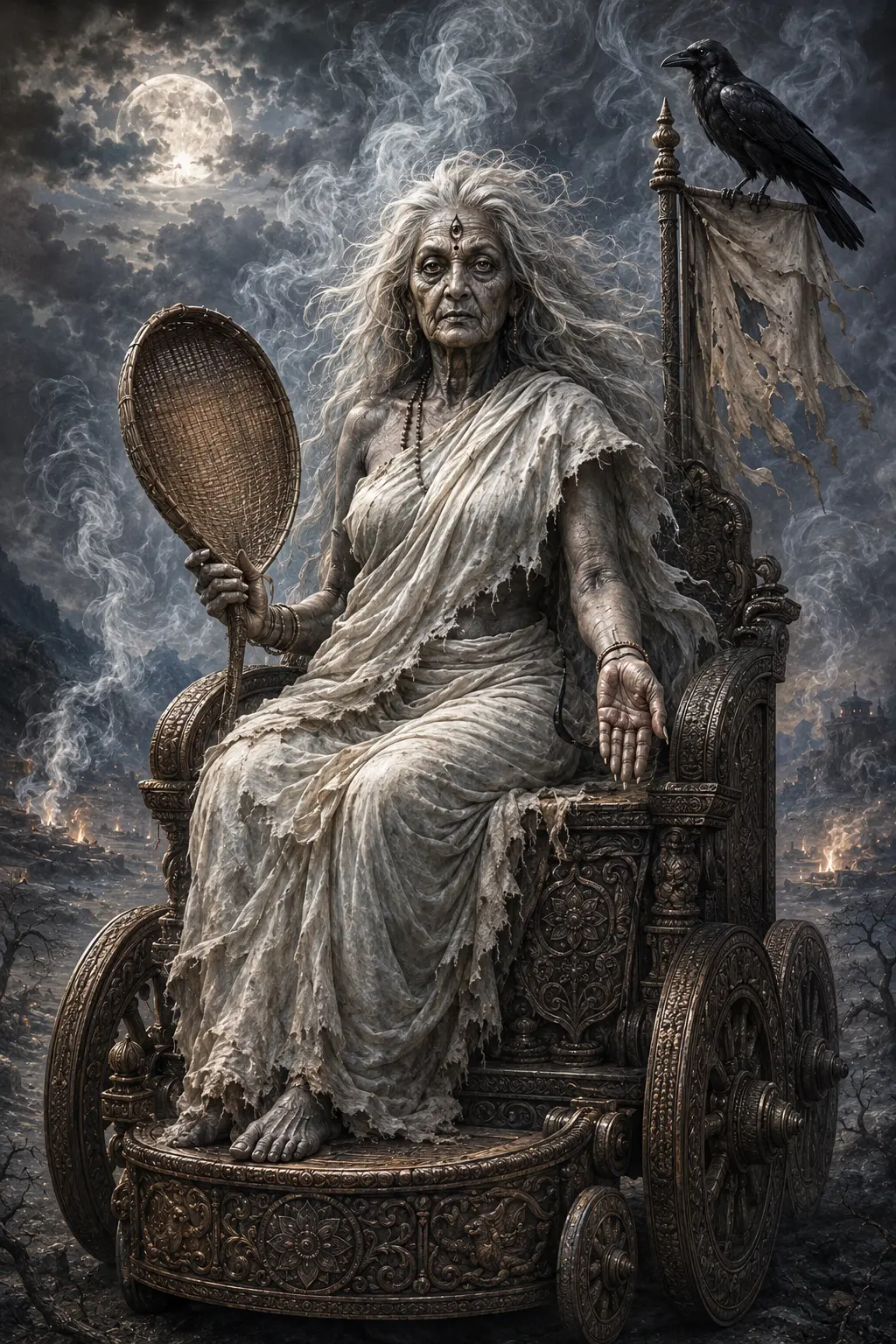
About This Artwork
This piece depicts Maa Dhumavati — the seventh of the Dasha Mahavidyas, the great crone goddess, the widow, the void — in her complete and utterly authentic sacred form. She is tall and gaunt, her smoky grey form radiating the energy of the sacred void, grey-white hair dishevelled and unbound, the deep-lined face of one who has seen through every illusion that existence offers. She is dressed in the simple plain white of the widow — the least ornamented, the least auspicious, the most deliberately unglamorous appearance in the entire Mahavidya pantheon. She is seated upright on her ornate horseless chariot — the chariot that moves without a horse, the self-propelling vehicle of the void that needs no external force because the void requires nothing to keep it in motion. On her banner, a large black crow — the messenger of truth, the bird that thrives where others fear to go, that sees clearly in darkness and announces the presence of the void without apology or decoration.
The palette — smoky grey, silver, deep twilight blue, and white, with the haunting orange glow of a full moon partially veiled by smoke clouds — is the most deliberately sombre in the entire collection. This is intentional. Dhumavati's palette is not sombre by failure; it is sombre by design. This is what the sacred emptiness looks like.
About Maa Dhumavati — The Most Misunderstood Mahavidya
Maa Dhumavati is the seventh of the Dasha Mahavidyas and the most deliberately inauspicious goddess in the entire Hindu tradition. She is old, thin, unglamorous, dressed in the plain white of widowhood, riding a horseless chariot with a crow on her banner. Everything about her appearance violates every convention of what a goddess is supposed to look like — every visual signal that the tradition normally uses to communicate divine power, beauty, and auspiciousness is deliberately absent or inverted in Dhumavati's form.
And this is precisely the point.
She is not accidentally unglamorous. She is the goddess who cannot be approached for worldly gain, who offers no wealth, no beauty, no power, no fame. She is the smoking aftermath of everything the ego valued being burned to ash. She is the silence after the fire. She offers only one thing: the direct encounter with reality as it is when all the beautiful veils have been stripped away. And that encounter — which the ego experiences as annihilation and the awakening consciousness experiences as the most profound peace it has ever known — is, in the tradition's assessment, the only thing that ultimately matters.
The Name — Dhumavati, the Smoky One
Dhumavati's name derives from the Sanskrit dhuma (smoke). She is the smoky one — associated with the smoke of the cremation ground, with the smoke after a fire has consumed everything it could consume, with the haze that remains when the vivid colours of ordinary experience have been burned away and what is left is the grey of exhaustion and the silver of something that has been through fire and survived.
In the iconographic tradition, she is also associated with the smoke of confusion, of delusion, of the thick obscurity of the conditioned mind — and with the cutting through of that smoke by the directness of encountering reality without the protection of comfortable belief. Her smoke is not simply the ash of what has been destroyed; it is the atmosphere of the encounter with what remains when destruction is complete.
The Horseless Chariot and the Crow
The two most distinctive elements of Dhumavati's iconography:
The horseless chariot: Unlike every other deity in the Hindu tradition who rides a specific vahana (vehicle) — Vishnu's Garuda, Shiva's Nandi, Durga's lion, Saraswati's swan — Dhumavati's chariot has no horse. It moves on its own, or it does not move. The horseless chariot signals that Dhumavati operates outside every ordinary system of cause and effect, every ordinary understanding of what makes things happen. The void does not need a driver. The emptiness is self-sufficient.
The crow (kaka): The crow is Dhumavati's vahana and her most important associated bird — the bird of Shani (Saturn, the planet of karma and limitation), of the ancestors, of the realms between life and death, of the liminal spaces where ordinary consciousness does not comfortably go. The crow sees clearly in the darkness. It thrives in the places associated with death and dissolution. It is the bird that announces the void's presence without softening the announcement.
Dhumavati's Iconographic Position Among the Mahavidyas
Dhumavati occupies the seventh position in the Mahavidya sequence — after Kali (dissolution), Tara (compassion), Tripura Sundari (beauty and grace), Bhuvaneshvari (cosmic spaciousness), Bhairavi (fierce solar fire), and Chhinnamasta (self-transcendence). Each of the first six has removed something from the practitioner's accumulated identity — something that seemed essential and proved not to be. By the seventh, what remains is the one thing that truly cannot be removed: the awareness that was always there beneath everything that has been stripped away. Dhumavati presides over the moment of encountering that awareness — the moment that feels like the end and is actually the beginning.
She is also one of only two Mahavidyas traditionally considered amavasya (new moon / dark fortnight) deities — deities whose worship is specifically associated with the darker, emptying phase of the lunar cycle. Her practice is typically associated with the dark fortnight and with the waning moon — the phase of letting go, of dissolution, of making space for what is to come by releasing what has been.
Displaying Maa Dhumavati
Maa Dhumavati's image is displayed in Shakta and Mahavidya practice spaces by those who work with the Mahavidya tradition in its complete form, including its most demanding aspects. Her seventh-position placement in a complete Mahavidya display reflects her specific role in the sequence.
This is not an image for general home decoration. It is an image for serious practitioners of the Shakta tradition who understand what Dhumavati represents and want her presence — the presence of the void, of sacred emptiness, of the most radical possible detachment — in their practice space. The grey, silver, and twilight palette requires a dark or neutral wall where the subtlety of the tones can read clearly. A simple silver or dark frame suits this artwork.