
About This Artwork
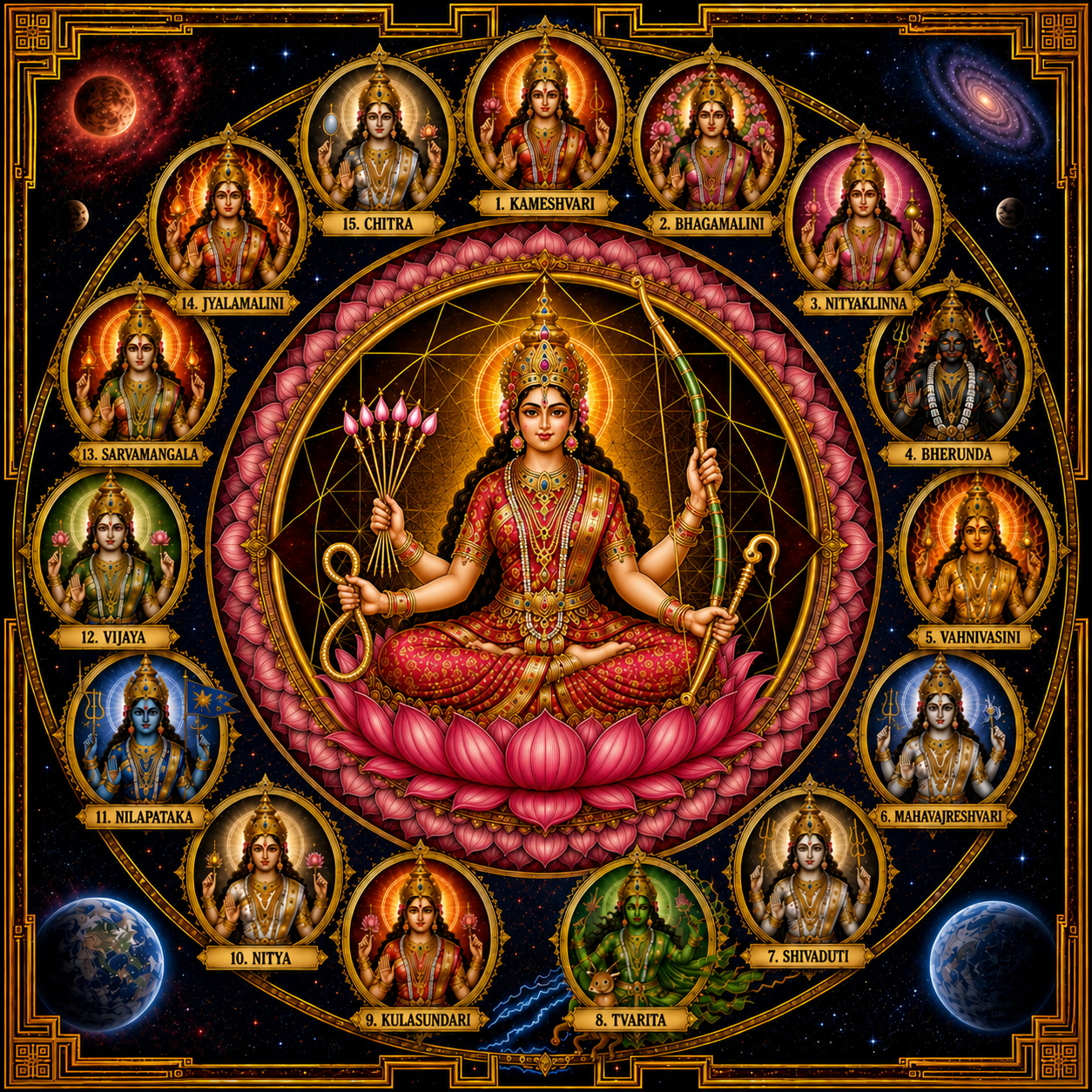
This piece depicts the Sixteen Nityas (Shodasha Nityas — shodasha = sixteen, nitya = eternal) of the Sri Vidya tradition in a complete circular mandala composition — the most comprehensive and most rarely depicted grouping in the entire Sri Vidya sacred art tradition. At the precise centre sits Shodashi Tripura Sundari herself — the sixteenth Nitya, the supreme form, seated on her pink lotus in all her radiant sovereignty, the complete fullness of the Sri Vidya tradition present in the central figure from whom all the others radiate.
Around her in fifteen smaller circular portraits, each numbered and arranged in the precise cosmological order of the tradition, are the fifteen individual Nitya goddesses: Kameshvari, Bhagamalini, Nityaklinna, Bherunda, Vahnivasini, Mahavajreshvari, Shivaduti, Tvarita, Kulasundari, Nitya, Nilapataka, Vijaya, Sarvamangala, Jyalamalini, and Chitra. Each is depicted in her specific form with her specific attributes, recognisable to any practitioner who has encountered the Nitya sequence in their sadhana.
The composition functions simultaneously as sacred wall art, as a complete visual reference to the Nitya sequence for practitioners who work with the Sri Vidya system, and as a living mandala — the sixteen eternal forms arranged in their cosmological order around the supreme form at the centre.
About the Sixteen Nityas — The Eternal Forms of Tripura Sundari
The Shodasha Nityas — the Sixteen Eternal Goddess Forms — are one of the most specialised and most profound elements of the Sri Vidya tradition, known primarily to practitioners who have entered the deeper levels of Sri Vidya sadhana. They are understood as the sixteen aspects or sub-manifestations of Shodashi Tripura Sundari, the supreme goddess of the Sri Vidya system, each corresponding to one of the sixteen lunar phases (tithis) of the Hindu lunar calendar.
The connection to the lunar calendar is not incidental. In the Tantric cosmological understanding, time itself — particularly the cycle of the moon — is a manifestation of the Shakti's expression. The sixteen lunar phases (from new moon through full moon and back) represent the complete cycle of Shakti's expression in the domain of time: the waxing and waning, the revealing and concealing, the fullness and the emptiness. Each Nitya presides over one lunar phase, and together the sixteen constitute the complete map of Shakti's temporal expression.
The Sixteen Nityas in Order
- Kameshvari — the goddess of desire fulfilled, presiding over the first lunar phase
- Bhagamalini — the goddess of the garland of the womb, the second phase
- Nityaklinna — the moist, perpetually wet goddess, third phase
- Bherunda — the terrible, the fierce, fourth phase
- Vahnivasini — the fire-dweller, fifth phase
- Mahavajreshvari — the great thunderbolt goddess, sixth phase
- Shivaduti — the one whose messenger is Shiva, seventh phase
- Tvarita — the swift one, eighth phase
- Kulasundari — the beautiful one of the Kula (lineage), ninth phase
- Nitya — the eternal one herself, tenth phase
- Nilapataka — the blue-bannered, eleventh phase
- Vijaya — the victorious, twelfth phase
- Sarvamangala — the auspicious to all, thirteenth phase
- Jyalamalini — the flame-garlanded, fourteenth phase
- Chitra — the variegated, the multi-coloured, fifteenth phase
- Shodashi / Tripura Sundari — the supreme sixteenth, the full moon, at the centre
The sixteenth — Shodashi, the full moon, Tripura Sundari herself — is the culmination and the source simultaneously: the full expression of Shakti in the domain of time (the full moon) and the timeless supreme from whom all fifteen phases arise and into whom they return.
The Nityas in Sri Vidya Practice
The Nityas are encountered in Sri Vidya practice in several contexts. The Tantraraja Tantra, one of the foundational texts of the Sri Vidya tradition, dedicates significant sections to the Nitya system — their mantras, their iconography, their cosmological positions, and their specific qualities as expressions of the one Shakti. Advanced Sri Vidya practice includes the worship of the Nityas in their specific sequence, understanding them as the living manifestations of the goddess in the temporal domain.
For practitioners at this level, the mandala composition in this artwork is not simply decorative — it is a complete reference map of the system they are working with, a visual anchor for the practice of the Nitya sequence, and a living mandala in the same sense that the Sri Yantra is a living mandala: the geometric arrangement of the forms in their cosmological order constitutes a complete sacred space, a complete altar, in a single frame.
The Relationship to the Sri Yantra
The Sri Yantra — the most complex and most complete yantra in the Hindu Tantric tradition — is the geometric body of Tripura Sundari, the sixteenth Nitya who is simultaneously the supreme form from whom all the others arise. The Sri Yantra is also available as a separate artwork in this collection. The relationship between the two:
- The Sri Yantra is Tripura Sundari's geometric body — the abstract, mathematical, geometric expression of the supreme goddess in the purest possible visual language.
- The Sixteen Nityas Mandala is the figurative expansion of that supreme form into her sixteen temporal expressions — Tripura Sundari at the centre, the fifteen phases of her temporal expression radiating outward.
For a complete Sri Vidya practice space, the two together constitute the most comprehensive possible visual representation of the tradition.
Displaying the Sixteen Nityas Mandala
The Sixteen Nityas Mandala is displayed in dedicated Sri Vidya practice spaces and on altars where the practitioner is actively working with the Nitya system. It requires a size large enough for the fifteen individual goddess portraits to be seen and distinguished — 11×14 is the minimum; 16×20 is recommended for any practice space where the image serves as a reference and a practice support rather than simply a devotional image.
The circular composition can be framed in a square frame (the classic approach for mandala artworks) or in a portrait frame where the circular composition is centred on the rectangular field. A gold or dark wood frame suits the deep cosmic palette.