
About This Artwork
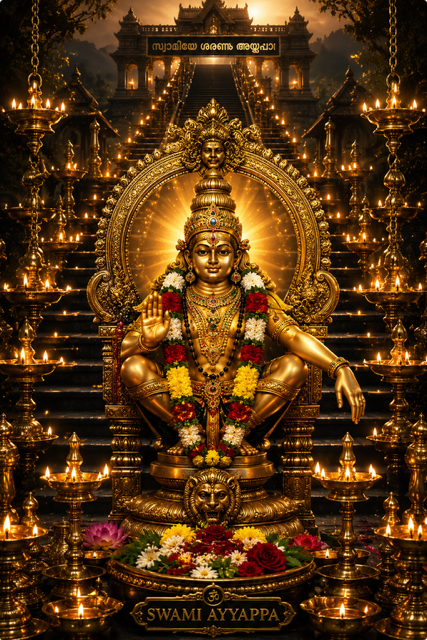
This piece depicts Swami Ayyappa — Lord of the Sacred Eighteen Steps, the presiding deity of the Sabarimala temple in the Western Ghats of Kerala — in the authentic darshan form in which he is encountered by the millions of pilgrims who complete the Sabarimala vrat each year. He sits in the characteristic yoga posture that identifies him above all others in the Hindu pantheon: the yoga pattam posture, with a cloth strap binding his raised right knee to his body, hands resting in the composed stillness of one who has been waiting here, in this posture, for all of time, for every devotee who will ever complete the vow that earns the right to stand before him.
His form glows in deep gold — warm, luminous, the colour of the oil lamp light that fills the Sabarimala shrine through the eighteen nights of the Mandala season. Colourful garlands of red, yellow, and white flowers cascade from crown to lap. A radiant halo behind his head declares the sacred energy that every devotee who has stood before the actual murti has described in their own way: an immediate, unmistakable, overwhelming sense of presence. On either side, rows of brass vilakku (traditional South Indian oil lamps) burn in the warm golden light of devotional offering, the same lamps that line every step of the approach to the shrine.
Behind him, the sacred eighteen steps (Pathinettampadi) rise in the background — each step associated with a specific quality or stage of the devotional journey, each tread worn smooth by the knees of millions of pilgrims who prostrate themselves before ascending. Above the steps, the golden gopuram of the Sabarimala temple rises against a warm luminous sky. Framing the entire composition, the devotional chant: Swamiye Saranam Ayyappa — Swami, I take refuge in you, I surrender to you, Ayyappa.
The palette of this artwork — deep warm gold, the amber of lamp light, the deep greens of the Western Ghats glimpsed behind the temple — is specifically the palette of Sabarimala: intimate, warm, lamp-lit, the quality of light in which millions of devotees have stood before this form and understood, perhaps for the first time, what the word surrender means.
About Swami Ayyappa — Lord of the Sacred Hill
Swami Ayyappa — also known as Dharma Sastha, Manikantha, Harihara Putra, and Sastha — is one of the most widely worshipped deities in South India and among the most actively pilgrimaged to in the entire Hindu world. He is the presiding deity of the Sabarimala Sri Dharmasastha Temple, situated at an elevation of approximately 914 metres in the Periyar Tiger Reserve of the Western Ghats in Kerala, and his annual pilgrimage season draws tens of millions of devotees from across India and the global South Indian diaspora — making Sabarimala one of the largest religious gatherings on earth, comparable in annual footfall to the Hajj at Mecca.
His name Ayyappa derives from the Tamil Ayya (father, respected one) and Appa (father) — the beloved father, the respected lord. His other names are equally revealing: Dharma Sastha (the Lord of Dharma, the sovereign of right conduct) and Manikantha (the jewel-throated one, from the bell — manikantha — worn around his neck that announced his divine presence to the royal family who raised him). Harihara Putra (the son of Hari and Hara — of Vishnu and Shiva) points to his most distinctive theological identity: he is the son of both Vishnu and Shiva, the offspring of the two supreme masculine principles of Vaishnavism and Shaivism simultaneously.
The Origin of Ayyappa — Son of Shiva and Mohini
Ayyappa's parentage is among the most distinctive in all of Hindu mythology. He is understood as the son of Shiva and Mohini — Mohini being the feminine form taken by Vishnu during the Samudra Manthan (the churning of the cosmic ocean) to deceive the asuras and distribute the amrita (nectar of immortality) only to the devas.
The story as told in the Bhagavata Purana and the Skanda Purana describes how Shiva, encountering Mohini in her most beautiful form, was irresistibly attracted — and from their union was born a son of extraordinary nature: one who carried within himself the combined energies of both the greatest of the Vaishnava tradition (Vishnu/Mohini) and the greatest of the Shaiva tradition (Shiva). This child — Harihara Putra, the son of Hari (Vishnu) and Hara (Shiva) — was left in the forest at Sabarimala and discovered by the childless king Rajashekhara of Pandalam, who raised him as his own son.
This origin makes Ayyappa the living embodiment of the unity of the two great streams of Hindu devotion — the Vaishnava and the Shaiva — in a single divine being. His worship draws together devotees from both traditions, and his temple is served by priests from both the Shaiva and Vaishnava lineages. In the Kerala context, where the relationship between these two great traditions has been complex across centuries, Ayyappa's unified parentage carries a specific peacekeeping and integrating theological significance.
The Yoga Pattam Posture — What It Means
The most immediately distinctive element of Ayyappa's iconography — present in virtually every image and murti of the deity across all traditions — is the yoga pattam posture: the right knee is raised and held in place by a cloth strap (pattam) that binds it to the body, while the hands rest in composed stillness.
This posture is understood in the tradition as the posture of the eternal ascetic — the yogi who has settled into the stillness of sustained inward practice and who sits in the same posture not for hours or days but for all of time, waiting with complete patience for every devotee who will ever complete the vow that earns the right to approach him.
The yoga pattam is specific to Ayyappa. No other major deity in the Hindu pantheon is depicted in this posture as their primary iconographic identification. It is Ayyappa's signature in the same way that the peacock feather is Krishna's, the trishul is Shiva's, or the lotus is Lakshmi's. A devotee who has been to Sabarimala recognises this posture immediately and viscerally — it is the posture in which the murti appears at the summit of the eighteen steps, the posture in which the deity has been waiting for the devotee through the forty-one days of the Mandala Vrat.
The Mandala Vrat — The Forty-One Day Observance
The primary devotional practice associated with Ayyappa is the Mandala Vrat — the forty-one day vrat (observance of discipline and austerity) that precedes the Sabarimala pilgrimage. The vrat begins with a formal initiation (diksha) in which the devotee takes on the irumudi (the twin-compartment bag that all Sabarimala pilgrims carry) and commits to a forty-one day period of strict discipline.
During the Mandala Vrat, devotees wear a specific dress code — the traditional black or blue cloth of the Ayyappa pilgrim — and observe a series of disciplines: celibacy, vegetarian diet, abstinence from alcohol and intoxicants, regular bathing, daily prayer and mantra, reduction of sleep, and the greeting of all other Ayyappa devotees with Swamiye Saranam Ayyappa rather than ordinary social greetings. The devotee addresses and is addressed by other devotees not by name but as Swami — acknowledging the presence of Ayyappa in every fellow pilgrim.
The effect of the forty-one day observance on the ordinary practitioner — particularly the lay householder who has a family, a job, and a social life — is typically described as transformative. The sustained discipline, the change of identity markers (the black cloth, the irumudi, the greeting), the awareness that thousands and then millions of other devotees are observing the same discipline simultaneously, and the daily reminder of the goal at the end of the forty-one days combine to create an experience of devoted commitment that is quite unlike any other practice in the Hindu tradition.
At the conclusion of the vrat, the devotee undertakes the pilgrimage to Sabarimala — typically on foot for at least part of the journey through the forest — and ascends the eighteen steps to stand before the murti of Ayyappa and receive his darshan.
The Sacred Eighteen Steps — Pathinettampadi
The eighteen steps (Pathinettampadi) that lead to the entrance of the Sabarimala shrine are among the most sacred physical structures in the Hindu pilgrimage tradition. No devotee may ascend them without carrying the irumudi — the twin-compartment bag that contains the offerings for Ayyappa (coconut filled with ghee, and other items) and the devotee's own provisions. The irumudi must be carried on the head, both hands used for the climb, as the devotee ascends on the knees.
The eighteen steps are associated with the eighteen Puranas, the eighteen chapters of the Bhagavad Gita, or — in the most widely transmitted Ayyappa tradition — with the eighteen hills of Sabarimala and the eighteen specific qualities or obstacles that the devotee must have addressed in themselves through the forty-one day vrat before being qualified to stand before the Lord.
The first step is associated with kama (desire), the second with krodha (anger), the third with lobha (greed), the fourth with moha (delusion), the fifth with madha (arrogance), the sixth with matsarya (jealousy), the seventh through twelfth with the five sense organs and the mind, and the thirteenth through eighteenth with the tattvams (philosophical principles) of the tradition. The ascent of the eighteen steps is therefore not simply a physical climb but a structured contemplation of the journey from the ordinary human condition toward the quality of surrender and purity that Ayyappa's presence at the summit represents.
The Devotional Chant — Swamiye Saranam Ayyappa
The chant that frames this artwork — Swamiye Saranam Ayyappa — is the most characteristic expression of Ayyappa devotion and the greeting through which Ayyappa devotees recognise each other during the Mandala season. Its meaning is direct and complete: Swamiye — O Lord, O Swami (the revered one, the master); Saranam — I take refuge, I surrender, I come for protection; Ayyappa — Ayyappa.
The chant is not a petition for something specific — it is a complete statement of the devotional relationship: the devotee approaching the Lord with the single offering of their complete surrender, asking nothing other than the Lord's acceptance of that surrender and the protection that flows from it. In the Ayyappa tradition, this chant is both the greeting between devotees and the devotee's fundamental prayer — the utterance that, through forty-one days of constant repetition, becomes the practitioner's deepest identity rather than simply a formula.
The Sabarimala Pilgrimage — Scale and Significance
The Sabarimala pilgrimage season — centred on the Mandala season (November/ December) and the Makaravilakku festival (mid-January) — draws the largest single religious gathering in the Kerala pilgrimage calendar and one of the largest in the world. Annual pilgrim numbers have been estimated at 40–50 million in peak years, making it comparable to the Kumbh Mela in scale, though its geography (a single hilltop temple accessible primarily through forest paths) makes the logistics considerably more demanding.
The pilgrimage draws devotees from across South India — Kerala, Tamil Nadu, Karnataka, Andhra Pradesh, and Telangana — and from the South Indian diaspora communities worldwide in Malaysia, Singapore, the United States, the United Kingdom, Australia, and across the Gulf. The image of millions of men in black or blue cloth making their way through the forest of the Western Ghats, carrying the irumudi on their heads, chanting Swamiye Saranam Ayyappa, is one of the most distinctive sights of the Indian devotional calendar.
The Makaravilakku festival on the night of Makara Sankranti (the winter solstice in the Malayalam calendar) is the most sacred night of the Sabarimala season — the night when the Makarajyoti (a star of light on the distant hill) appears and the prabhadeepam (the sacred flame) is lit at the temple. Devotees who have undertaken the full Mandala Vrat specifically to be present at Sabarimala for Makaravilakku describe this as the most powerful devotional experience available within the Ayyappa tradition.
Displaying Ayyappa in the Home
Ayyappa's image is displayed in South Indian Hindu households — particularly Malayalam, Tamil, Kannada, and Telugu families — as a matter of devotional practice, most significantly in families where the adult male members have completed the Mandala Vrat and the Sabarimala pilgrimage. The image in the home puja room is understood in this context as the continuation of the relationship established at Sabarimala — the deity who was encountered at the summit of the eighteen steps is now present in the home, awaiting the devotee's daily acknowledgement.
The devotional salutation Swamiye Saranam Ayyappa — spoken before the image as part of morning prayers — is the most direct and most complete expression of the relationship.
In a puja room, Ayyappa's image is typically placed in a position of honour alongside or separate from the family's primary household deities. During the Mandala season, the image becomes the focus of the household's devotional energy as the family member undertaking the vrat observes the forty-one day discipline.
The warm golden lamp-lit palette of this artwork — the vilakku flames, the golden form, the amber glow of the Sabarimala atmosphere — makes it one of the most immediately recognisable and most emotionally resonant Ayyappa images available. Print on matte paper at any professional print shop at your preferred size.