About This Artwork
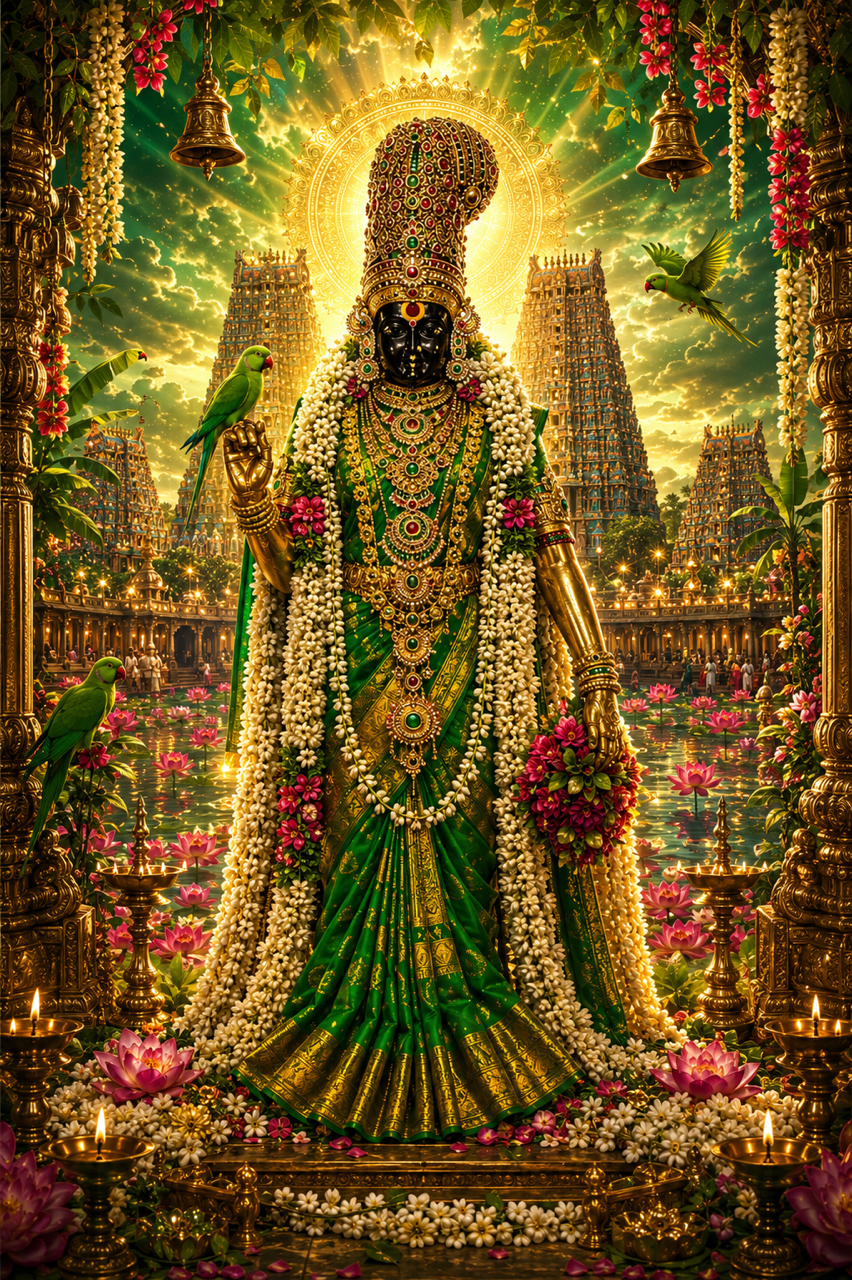
This piece depicts Meenakshi Amman — Minakshi Devi, the fish-eyed goddess who is the presiding deity of Madurai in Tamil Nadu and one of the most magnificent expressions of the divine feminine in all of Indian sacred tradition — in the authentic temple darshan of her most characteristic form. Her complexion is the luminous golden-green associated with her specifically — not the warm rose-gold of Tripura Sundari or the deep dark of Kali, but a specific green-gold that is the colour of the parrot (Meenakshi's sacred bird), of the ocean at the point where depth becomes sunlit, of the goddess who is simultaneously emerald-green and gold in her most complete expression.
She is dressed in a green and gold silk sari of extraordinary beauty, with elaborate gem-studded jewellery at crown, ears, throat, and wrists. Long white jasmine garlands and pink flower garlands cascade from crown to waist. In her hand and beside her, two green parrots rest — the parrots that are Meenakshi's constant companions and the embodiment of her sacred speech, the ones through whom she communicates the secrets of the path to those who come to her.
Behind her, the extraordinary architectural complex of the Meenakshi Amman Temple rises: the famous multi-tiered gopurams (gateway towers) covered in thousands of carved and painted figures, the lotus pond (Porthamarai Kulam — the golden lotus tank) whose banks receive devotees who come to sit and look at the goddess's reflection in the sacred water, the long pillared corridors of the thousand-pillared hall.
About Meenakshi Amman — The Fish-Eyed Goddess
Meenakshi (Minakshi — meen, fish + akshi, eyes) is the goddess whose eyes are said to have the beauty and the depth of fish — the eyes that see everything beneath the surface, that move through the depths without losing themselves, that are perfectly adapted to the world in which they exist. The name points to the specific aesthetic of Meenakshi's presence: the depth, the clarity, and the beauty of perception that characterises the goddess who has been worshipped at Madurai for at least two thousand years.
She is understood as a form of Parvati — the great goddess, the consort of Shiva — in her most sovereign and most independently powerful aspect. Unlike some forms of Parvati that are explicitly the consort form (Shiva-Parvati, Ardhanarishwara), Meenakshi in her Madurai manifestation is primarily sovereign in her own right: she rules the city, she built the temple complex, she chose Sundareshwara (Shiva) as her husband rather than being given to him. She is the queen of Madurai, and Sundareshwara is her consort as much as she is his.
The Meenakshi Amman Temple — One of the World's Great Sacred Buildings
The Meenakshi Amman Temple in Madurai is among the largest and most architecturally extraordinary temple complexes in the world. The complex covers approximately 14 acres and features fourteen gopurams (gateway towers) ranging in height from 45 to 52 metres, each covered in thousands of stucco figures of deities, mythological beings, and sacred narratives painted in vivid colours. The temple complex includes the main sanctum of Meenakshi, the sanctum of Sundareshwara (Shiva), the Pottramaraikulam (golden lotus tank), the thousand-pillared hall, multiple mandapams (pillared halls), and a collection of smaller shrines.
The temple's origin is traditionally dated to the first century CE, though the current structures date primarily from the 16th–17th centuries (the Nayak period). It has been in continuous worship for at least two thousand years, making it one of the oldest continuously used sacred sites in the world.
Approximately 15,000–20,000 visitors come to the temple each day — a number that rises dramatically during major festivals. The Meenakshi Tirukalyanam (the celestial wedding of Meenakshi and Sundareshwara) celebrated in the month of Chithirai (April/May) is among the most important festivals in Tamil Nadu and draws visitors from across the world.
Meenakshi's Parrots — The Sacred Birds of the Goddess
The green parrots that attend Meenakshi in this artwork are her most distinctive associated animal — more specific to her than the lion that many goddess forms ride, more intimate than the attendant vehicles of other deities. Meenakshi's parrots are present in her temple iconography, in her festival processions, and in the stories told about her: they speak with the voices of her devotees, they carry the prayers of pilgrims to the goddess's ears, and their emerald green is the visual echo of the specific green-gold of Meenakshi's own complexion.
In the Tamil Shaiva tradition, the parrot is also the vehicle of Kama (the god of love) — and Meenakshi's parrots carry the same erotic and devotional associations: they are the birds of love, of beauty, of the divine speech that communicates what ordinary language cannot reach.
The Lotus Pond — Pottramaraikulam
The golden lotus tank (Pottramaraikulam) visible in the background of this artwork is one of the most sacred spaces within the Meenakshi temple complex. The tradition holds that Shiva himself tested the true worth of Tamil literary works by placing them in the tank — those that were genuinely great floated, and those that were not sank. The tank is therefore the ultimate test of authentic spiritual value in the Tamil tradition, and its presence in Meenakshi's temple confirms that truth and beauty are the same thing, and that the goddess's city is the place where that identity is most directly available.
Displaying Meenakshi Amman in the Home
Meenakshi Amman's image is displayed in Tamil Hindu homes across every community, and in all South Indian homes where the goddess is the kuladevata (family deity) or where the Madurai tradition holds special significance. For the Tamil diaspora across Southeast Asia (particularly Malaysia and Singapore, where Tamil Hindu culture has flourished for generations), the United Kingdom, North America, and Australia, the Meenakshi image carries the specific quality of connection to the sacred homeland of Madurai.