About This Artwork
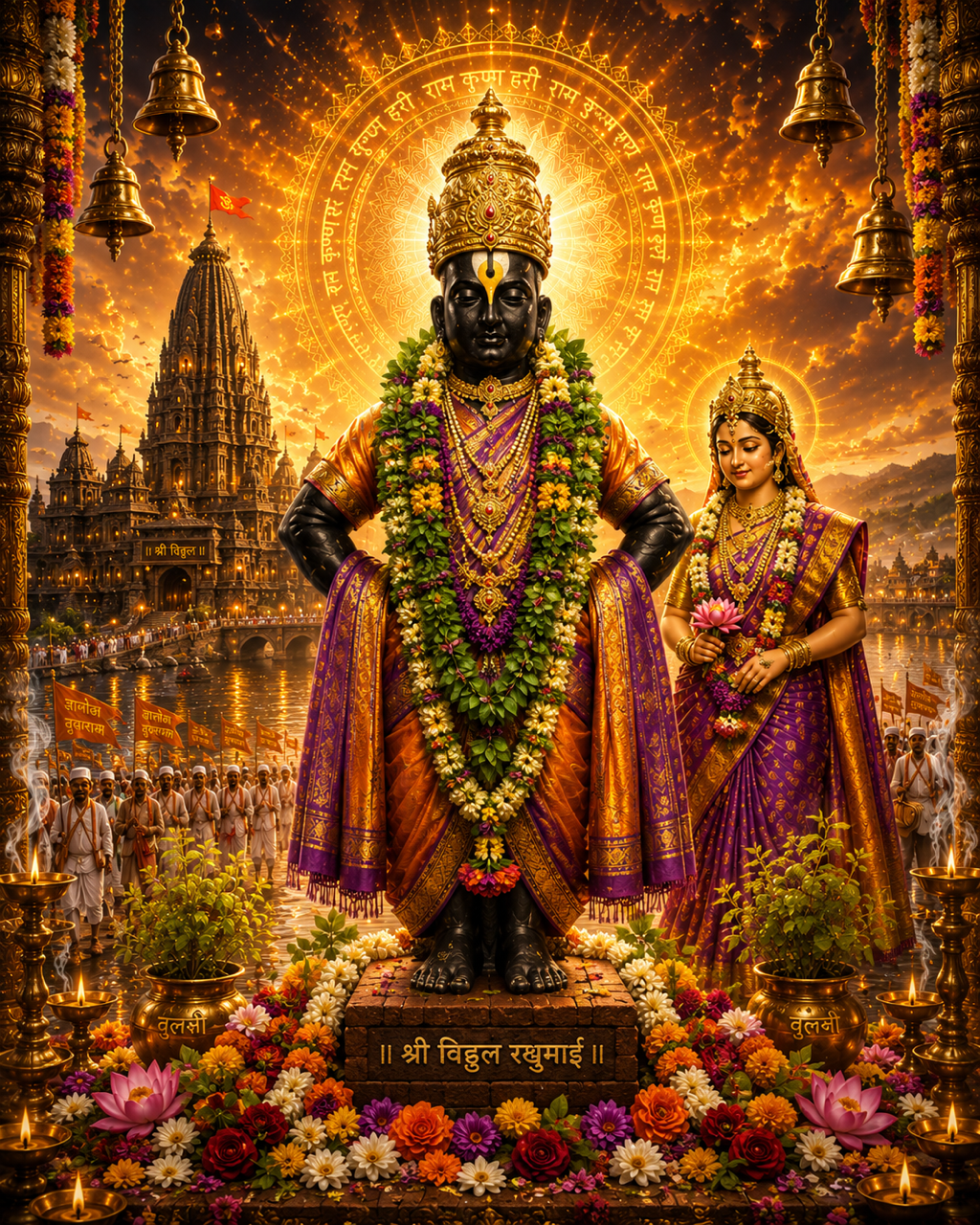
This piece depicts Vitthal and Rukmini — the divine pair enshrined at the Pandharpur Vitthal Rukmini temple on the banks of the Bhima river in Maharashtra, the presiding deity of the Warkari tradition and one of the most beloved of all the forms of the divine in the Marathi-speaking world. Vitthal (also Pandurang, Panduranga, Vitthoba) stands in his characteristic posture that no other deity in all of Hinduism replicates: both hands firmly on the hips (the kati-hasta or akimbo posture), the entire body weight balanced, the bearing one of complete availability and complete composure — the deity who is waiting, who has been waiting for centuries, for the devotees who are making their way toward him on the long roads of the Warkari pilgrimage.
His black stone form is dressed in orange and purple silk, the golden crown rises above his serene face, and sacred tulsi garlands cascade from his neck. Beside him, Goddess Rukmini — Rakhumai, the Lord's beloved consort — stands in purple and gold, holding a lotus, her presence completing the divine pair that Pandharpur is dedicated to.
Behind them, the great Pandharpur temple rises on the bank of the Chandrabhaga (Bhima) river, and in the middle distance, a procession of Warkari pilgrims approaches carrying their distinctive flags — the palkhis (palanquins) that carry the paduka (sandals) of the great Warkari poet-saints across the hundreds of kilometers from Dehu (Tukaram's village) and Alandi (Dnyaneshwar's resting place) to Pandharpur, twice a year, for the Ashadhi and Kartiki Ekadashi festivals.
Around the halo above their heads, the words: Ram Krishna Hari — the Warkari greeting, the chant that is repeated on the roads of the pilgrimage, the name of the divine in its most universal and most simple form.
At the base, in Devanagari script: श्री विठ्ठल रखुमाई — Shri Vitthal Rakhumai.
About Vitthal — Panduranga of Pandharpur
Vitthal — also known as Pandurang (the white/pale-complexioned one), Panduranga, Vitthoba, and Vithoba — is the presiding deity of the Pandharpur temple in Solapur district, Maharashtra. He is understood as a form of Vishnu or Krishna, though the precise theological identification has been debated across the Varkari tradition's own literature. What is not debated is the devotional reality: Vitthal is the beloved, the one for whom the Warkaris have walked hundreds of kilometers twice a year for over seven centuries, the deity whose presence at Pandharpur is the destination that gives the entire tradition its direction and meaning.
The posture that makes Vitthal instantly recognisable — both hands on the hips, the akimbo stance — is understood in various ways across the tradition. The most widely told story says that Vitthal came to visit his devotee Pundalik in Pandharpur but found Pundalik serving his aged parents and unwilling to interrupt that service even for the Lord. Pundalik tossed a brick for Vitthal to stand on while he waited, and Vitthal — moved by the depth of his devotee's parental love — stood on the brick with hands on hips, waiting. And he has been waiting there ever since, on the brick (the pindi or pedestal at the base of the murti), arms akimbo, for every devotee who is making their way toward him through the circumstances of their life.
The Warkari Tradition — Seven Centuries of Walking
The Warkari tradition (Vari — the pilgrimage; Warkari — the one who makes the vari) is a bhakti (devotional) movement that has been walking to Pandharpur twice a year — for the Ashadhi Ekadashi (June/July) and Kartiki Ekadashi (October/November) — since at least the 13th century CE, and possibly earlier. The tradition was shaped by a succession of poet-saints whose Marathi devotional poetry (the abhangas) is among the greatest literature in any Indian language: Dnyaneshwar (Jnaneshwara, 1275–1296 CE), Namdev (1270–1350 CE), Eknath (1533–1599 CE), and Tukaram (1608–1649 CE) are the four principal Warkari saint-poets whose paduka (sandals) are carried in the palkhis to Pandharpur.
The annual Warkari pilgrimage — during which hundreds of thousands of devotees walk from across Maharashtra, singing the poet-saints' abhangas, chanting Ram Krishna Hari, and greeting each other as Mauli (mother) — is one of the most distinctive, most democratically egalitarian, and most continuously practiced pilgrimage traditions in the world. It makes no distinction of caste, community, gender, or social status on the road to Pandharpur: everyone walks together, everyone sings together, and everyone is Mauli to everyone else.
Rukmini — Rakhumai, the Lord's Beloved
Goddess Rukmini — called Rakhumai (beloved mother) in the Marathi devotional tradition — is Vitthal's consort and is worshipped in her own right in a separate shrine within the Pandharpur temple complex. She is understood as the beloved wife of Krishna (in the Krishnaite reading of Vitthal) whose story of choosing her own husband against her family's wishes is among the most celebrated of the Puranic narratives of the divine feminine's agency. Her presence beside Vitthal in the temple — and in this artwork — constitutes the complete divine pair: the Lord who waits, and the Lady whose love brought him to this place.
Ram Krishna Hari — The Warkari Greeting
The three names inscribed in the halo of this artwork — Ram Krishna Hari — are the universal Warkari greeting. On the roads of the pilgrimage, every devotee addresses every other devotee with this greeting; it replaces ordinary social salutations with the names of the divine. Ram (the ideal human), Krishna (the cosmic beloved), Hari (the remover of sorrow) — the three names together constitute a compressed statement of the Vaishnava understanding of the divine in its most universally applicable form.
Displaying Vitthal Rukmini in the Home
Vitthal's image is the central sacred image of Maharashtrian homes across every community. For those from Maharashtra and from the Warkari tradition specifically, the Vitthal-Rukmini pair in this artwork is the most fundamental of all possible sacred images — the Lord who is always waiting, always available, always receiving with hands on hips whatever the devotee brings.