About This Artwork
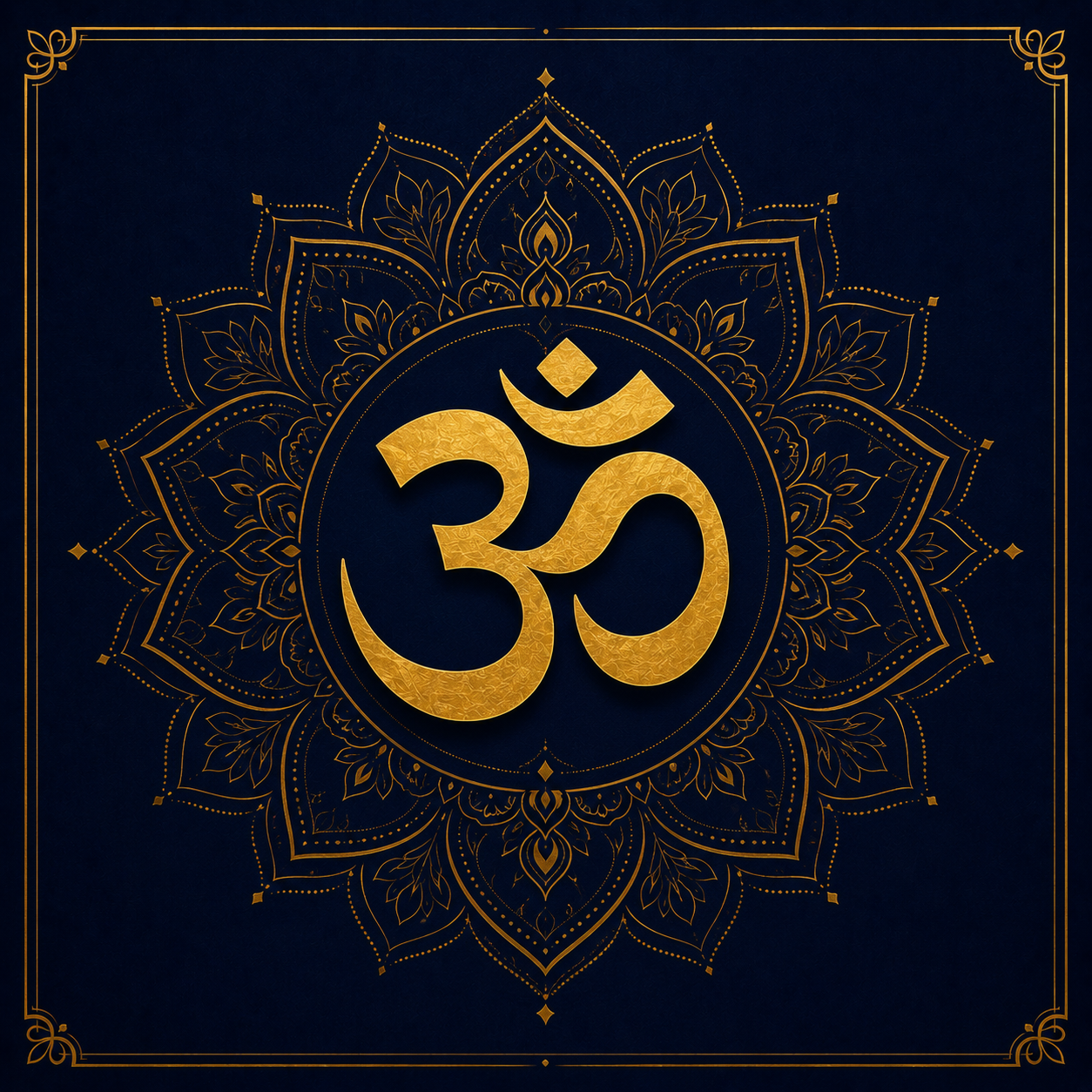
This artwork depicts the sacred Aum symbol — the most universally recognised symbol of the yoga and meditation tradition — in a composition of extraordinary visual clarity and sacred intention. The Aum (ॐ) in its traditional Devanagari form is rendered in luminous gold at the precise centre of the composition, large and absolutely clear. Around it, a detailed symmetrical mandala of intricate gold floral-geometric patterns radiates outward in concentric rings of precision and beauty. The outer boundary is a simple gold square border — the bhupura, the outer gate, the threshold between the ordinary and the sacred.
The result is not simply a symbol with decoration. It is a yantra in the truest sense: the Aum symbol held within its own geometric field, the sound-form and the geometric-form of the same reality placed together in a single visual statement. The Aum is the content; the mandala is the field; the composition together is a map of the relationship between the two — the specific sound-vibration and the infinite geometric intelligence from which it arises and within which it resounds.
The palette — deep navy blue as the infinite ground, brilliant gold as the symbol and its geometric surround — is the most focused and most legible composition in the entire Yantras & Sacred Symbols section. The Aum symbol is immediately recognisable to virtually every yoga practitioner worldwide regardless of their specific tradition or background, making this the most universally accessible piece in the collection.
About Aum — The Primordial Sound
Aum (also written Om, the two being different romanisations of the same Sanskrit syllable ॐ) is the most fundamental sacred sound in the Hindu, yogic, and broader Indian spiritual traditions. It is described in the Upanishads — the philosophical texts that form the basis of Vedanta — as the Pranava: the primordial vibration, the original sound, the syllable from which the entire manifest universe arises and to which it eventually returns.
The Mandukya Upanishad — one of the most concise and most philosophically complete of all the Upanishads, consisting of just twelve sentences — is devoted entirely to the nature of Aum. Its teaching is that Aum encompasses the entire range of human experience and consciousness, and that understanding Aum completely is equivalent to understanding the nature of Brahman — the absolute reality that underlies all of existence.
The Four Parts of Aum — What the Symbol Encodes
The traditional Devanagari Aum symbol (ॐ) consists of four parts, each corresponding to a dimension of consciousness and a level of existence.
The lower curve (A): the first sound of Aum — the waking state (jagrat), the realm of ordinary conscious experience, the world of objects perceived by the senses. The sound A opens the mouth completely — it is the most open, most outward-facing of all vowels, the first sound that arises from silence.
The upper curve (U): the second sound — the dreaming state (svapna), the realm of the mind's own creations, the world of images, narratives, and the subtle body's experience during sleep. Between the full outward openness of A and the closing toward silence of M, U occupies the intermediate realm.
The closing curve (M): the third sound — deep sleep (sushupti), the state of consciousness without objects, without images, without content of any kind. M closes the mouth; the sound ends at the lips; consciousness turns completely inward into its own undifferentiated ground.
The dot above and the arc beneath it: the virama — the fourth element, representing the fourth state (turiya, literally "the fourth") that underlies and transcends all three. Turiya is not a state that alternates with the other three; it is the awareness within which all three arise and pass. The dot is the bindu — the point of pure consciousness, dimensionless and undivided, the Aum's geometric equivalent of the silence from which sound arises.
The arc beneath the dot is the maya — the veil, the illusion — the threshold between turiya and the other three states. The dot floats above the arc, signalling that turiya is always already present but separated from ordinary awareness by the arc of illusion. The spiritual path, in the Mandukya's framework, is the dissolution of this arc — the direct recognition of the turiya that was always already the ground of the other three states.
Aum in Yoga Practice
Every yoga class — across every tradition and lineage, whether physically rigorous or deeply meditative, whether rooted in the most ancient Tantric systems or in the most contemporary wellness context — begins and ends with Om. This is not a coincidence or a convention. It is the living transmission of the understanding that the practice begins and ends in the primordial sound, and that the movement from Om to Om is the movement from the silence before practice through all the work of the practice back to the silence that was always already there.
The three sounds of Aum — A-U-M — correspond to the three stages of the practice itself: A to the beginning, the opening of awareness to what is present; U to the middle, the sustained work of the practice in which the awareness moves through what is encountered; M to the closing, the return to stillness and integration. And the silence after M — the pause, the virama — is the turiya: the recognition that the practice was always happening within the awareness that is always already here.
In pranayama (breath regulation), Aum is used as a timing mechanism: the length of the inhalation measured in Aum repetitions, the kumbhaka (retention) measured in Aum repetitions, the exhalation measured in Aum repetitions. In mantra japa (repetitive mantra recitation), Aum is the first syllable of virtually every mantra in the Sanskrit tradition — the universal opening that establishes the vibrational ground from which every specific mantra's quality then arises.
Aum as the Universal Sound — Cross-Tradition Resonances
The identification of a primordial creative sound at the origin of existence is not unique to the Hindu tradition. The Gospel of John begins: "In the beginning was the Word, and the Word was with God, and the Word was God." In the Jewish mystical tradition, the act of creation in Genesis is a divine speech act — God speaks the world into being. In Islam, the Quran is understood as the direct word of God — uncreated, eternal, the foundation of existence. In Tibetan Buddhism, the mantra Om Mani Padme Hum begins with the same primordial syllable.
These convergences are not coincidences. The intuition that sound precedes form, that vibration underlies matter, that the universe is fundamentally an acoustic phenomenon — this is an intuition that the deepest investigations of consciousness in every tradition have independently reached. In modern physics, the same insight appears from a completely different direction: the quantum field theory in which matter itself is understood as excitations of underlying fields of vibration, the universe as a vast harmonic structure of interfering wave patterns.
The Aum as the symbol of this primordial sound is therefore not a culturally specific religious symbol. It is an attempt — in the specific form of the Sanskrit syllable and the Devanagari character — to point toward something universal about the nature of existence that has been recognised across traditions, across methods, and across millennia.
The Mandala Surround — Aum as the Source of Geometry
The mandala of gold geometric patterns surrounding the Aum symbol in this artwork is not decorative framing. It is a theological statement: the geometric order of the cosmos — the concentric rings, the radial symmetry, the floral patterns — arises from the primordial sound at its centre. Aum is the source; the mandala is the field it generates.
In the Nada Brahma tradition — the understanding that the universe is sound — all geometry is the frozen form of vibration. The shapes of sacred geometry — circles, polygons, flower patterns, star patterns — are the visual forms of specific frequencies of the primordial vibration. The mandala around the Aum symbol is the geometry that the Aum generates when it is allowed to organise itself into visible form — the way a Chladni pattern of sand on a vibrating plate organises itself into a mandala when a specific frequency is applied.
This is not speculation. Cymatics — the study of visible sound, the visualisation of sonic vibration in matter — produces precisely these forms: symmetrical, radially organised, intricate geometric patterns that grow more complex and more beautiful as the frequency increases. The mandala is what Aum looks like.
Displaying the Aum Om Symbol
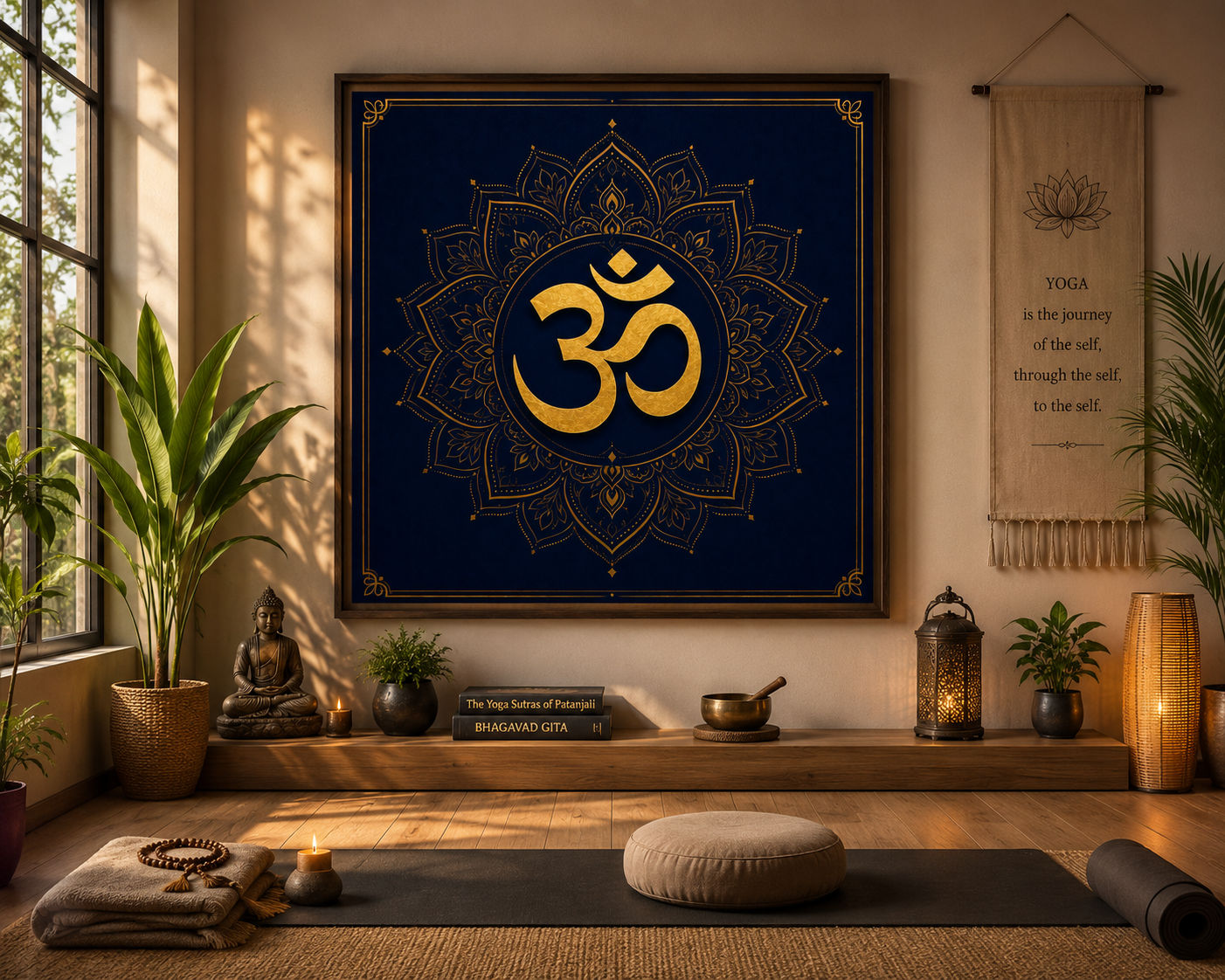
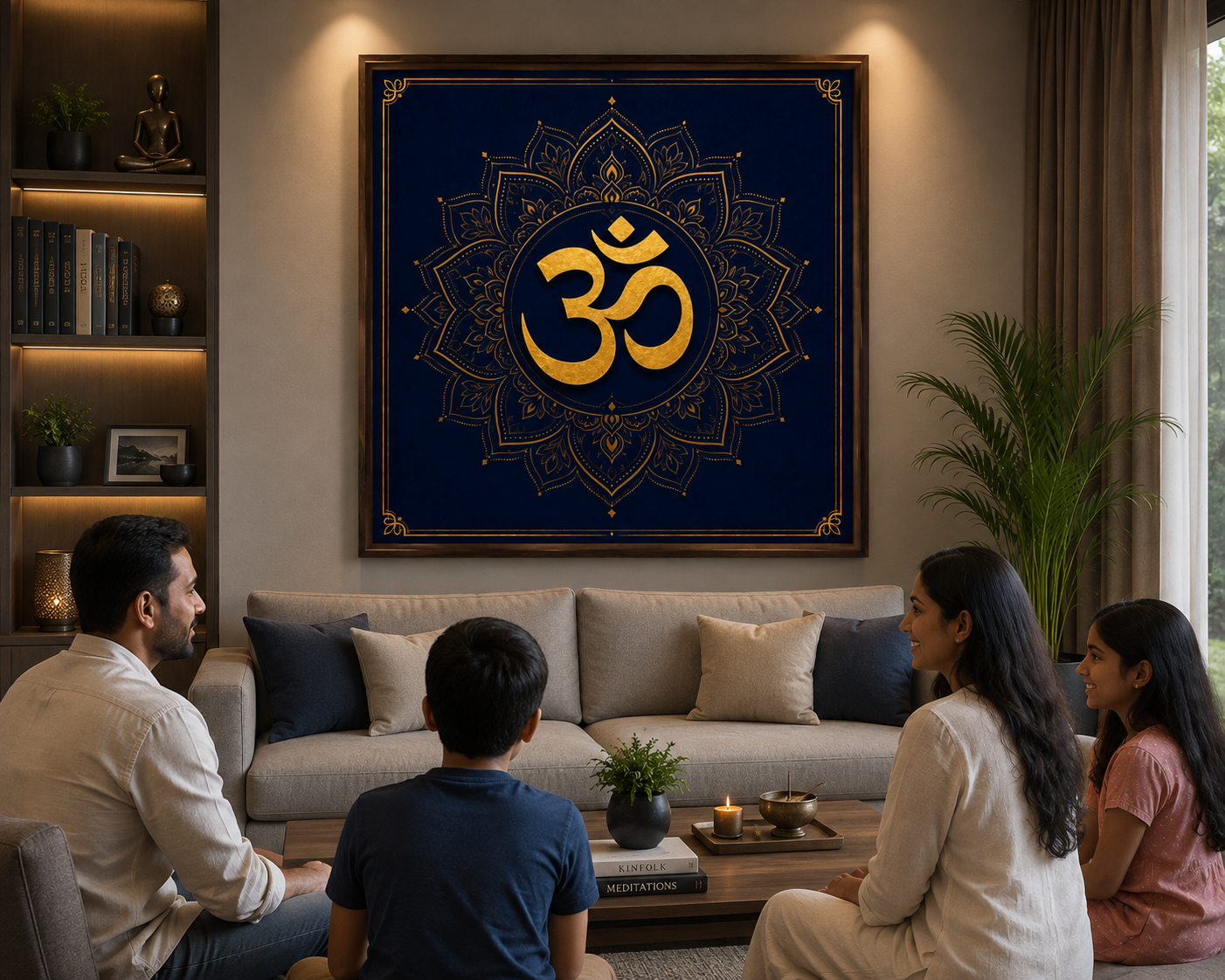
The Aum symbol is the most widely displayed sacred symbol in yoga studios, meditation rooms, and wellness spaces worldwide — across every culture and background that has been touched by the global yoga movement. Its recognisability is extraordinary: the ॐ symbol in any form communicates "sacred space," "yoga," "meditation," "the search for something deeper" immediately and without any need for explanation.
This artwork renders the Aum in its most traditional, most visually complete form — large, luminous, precisely formed Devanagari gold on deep navy, held within an intricate mandala. It is not a minimalist Om on white; it is the Om in its full sacred-geometric context, the symbol in its field, the sound in its universe.
Customers have noted that the gold and deep navy colours look even better printed than on screen — the combination of these two specific tones has a particular quality in print that screen displays cannot fully replicate. Print on matte or semi-gloss photo paper at FedEx Office, Staples, or Walgreens Photo.
A gold or dark navy frame suits this composition. The composition is square — use a square frame. The Aum symbol should be oriented with the main body right-side up and the virama dot at the top.