
About This Artwork
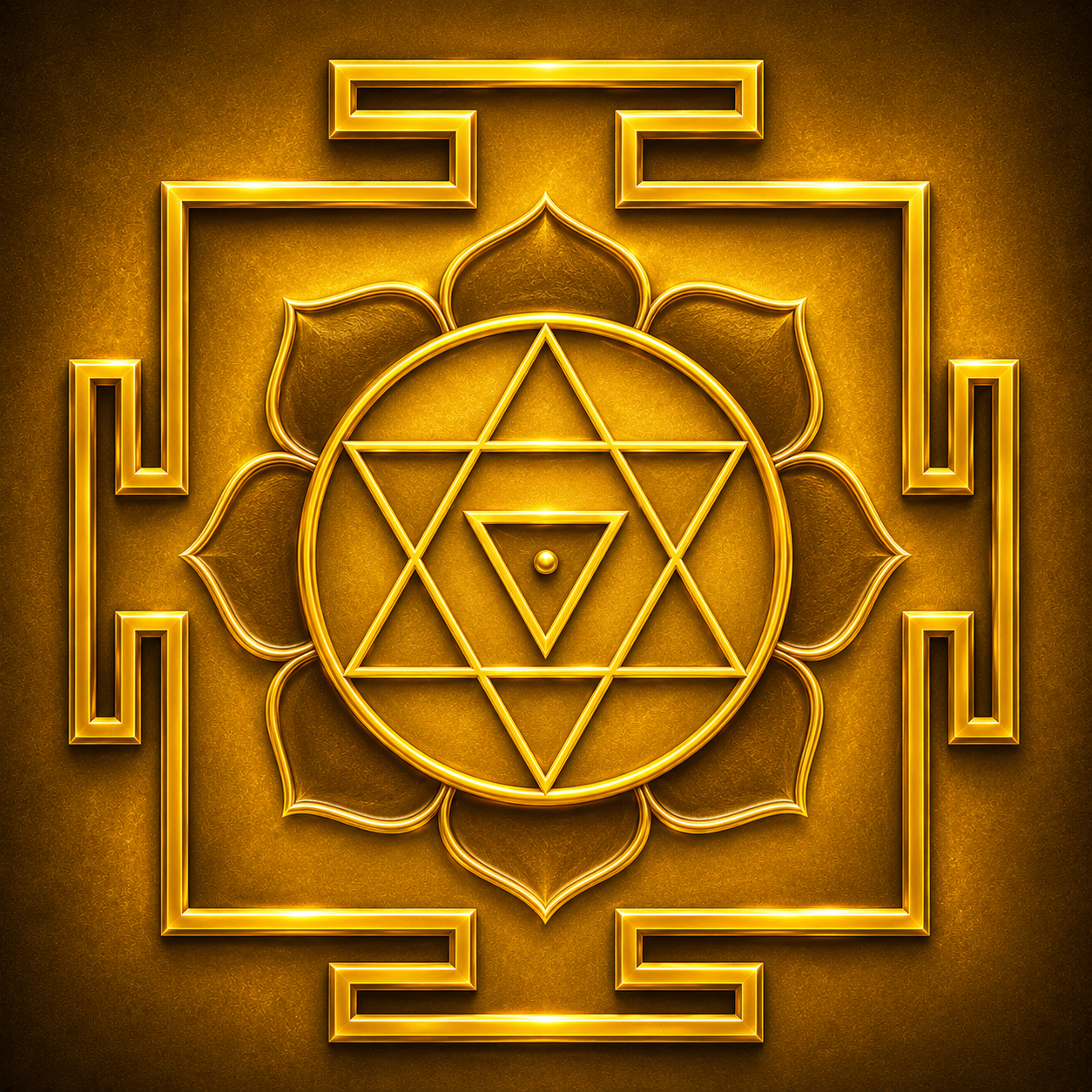
The Bagalamukhi Yantra is rendered in brilliant yellow and gold — the prescribed palette of Maa Bagalamukhi, the eighth Mahavidya, known as Pitambari, the yellow-robed one. The upward-pointing triangle at the centre is the Shiva trikona: consciousness ascending, clarity rising above confusion, the discriminative intelligence (viveka) that her stambhana power ultimately expresses.
At the precise centre sits the golden bindu where her concentrated presence resides. Yellow lotus petals bloom outward in the colour of turmeric — the colour of sacred purification and of the clarity that naturally stills whatever was causing turbulence.
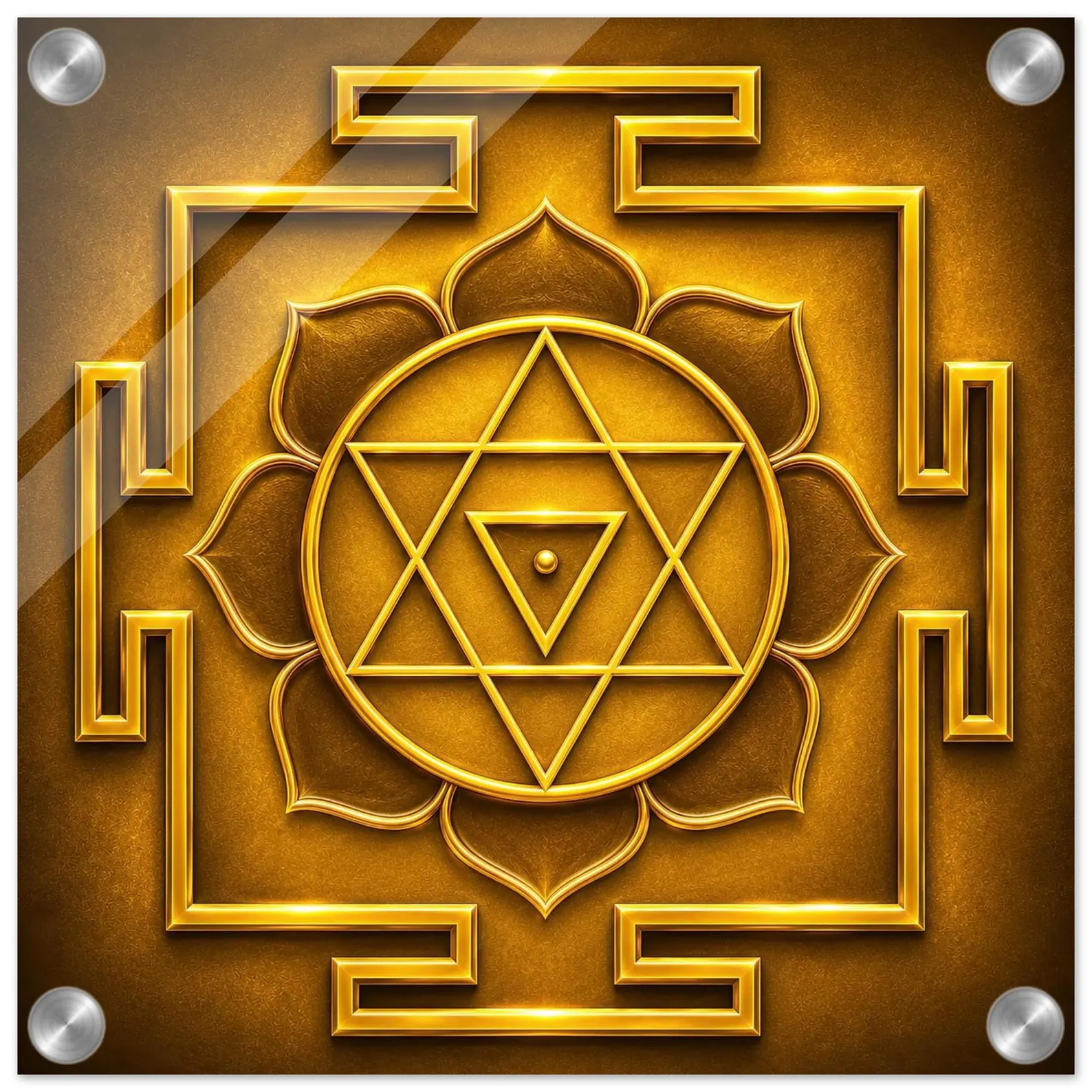
The brilliant yellow of this yantra is the most immediately vibrant in the collection, and the acrylic format particularly enhances the saturation of the yellow against the brilliance of the gold geometry.
Stambhana in geometric form
Bagalamukhi's defining power is stambhana — stilling, arresting, bringing to a halt. It is often described in terms of stopping an opponent, but the tradition's deeper reading is internal: what is stilled is the churning of confusion that makes clear action impossible.
The upward triangle is the instrument of that stilling. Discriminative intelligence rises, cuts through the confusion at its root, and what was agitated simply stops moving. Nothing is destroyed; everything is brought to its right position.
Turmeric yellow
The yellow of this yantra is prescribed, not decorative. Haridra — turmeric — is the purifying, obstacle-clearing, clarity-producing sacred substance of the Indian household and the ritual altar alike, and Bagalamukhi's worship uses it directly: turmeric water, turmeric malas, turmeric-dyed cloth.
The yantra encodes that quality in colour. To look at it is to be given the visual equivalent of the substance itself.
Eighth in the Mahavidya sequence
Bagalamukhi occupies the eighth position among the ten Mahavidyas — the moment of crystallisation, where the clearing work of the previous seven consolidates into a stable clarity that can be acted from.
Practitioners often turn to her yantra in circumstances requiring decisive speech, legal or adversarial clarity, or the resolution of a long-running confusion.
Display
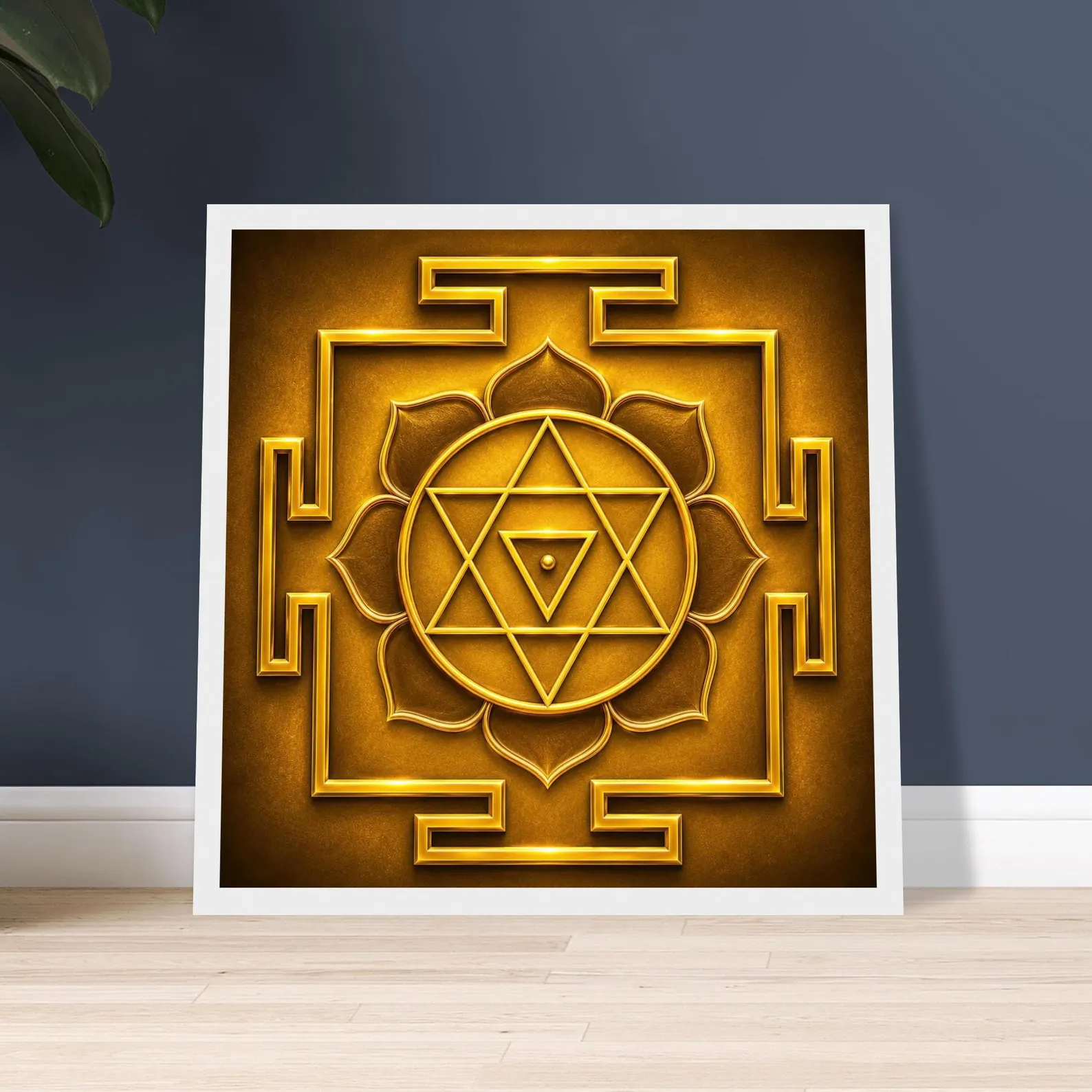
A natural wood or gold square frame suits the palette. A white or neutral wall allows the yellow to read at full saturation; a strongly coloured wall will fight it.
It works especially well displayed alongside the Bagalamukhi deity image as a pair — the goddess in form and the same goddess in geometry.
What Is a Yantra?
A yantra — Sanskrit for that which holds or restrains — is a sacred geometric diagram used in the Hindu Tantric tradition as a visual form of the divine. It is not understood as a symbol standing in for a deity, but as the deity expressed in geometry. Where a murti gives the deity human form and a mantra gives the deity sound, the yantra gives the deity line, triangle, circle, petal, and enclosure.
Read from the outside inward, a yantra is built in five stages:
- Bhupura: the outermost square with T-shaped gates on four sides — the four directions, and the four entries into sacred space.
- Lotus petals: one or more rings blooming outward — the opening of consciousness in the deity's presence.
- Circles: cosmic horizon bands — wholeness, and the completion of cycles.
- Central geometry: the triangles, hexagrams, or complex arrangements specific to each deity.
- Bindu: the dimensionless central point — the deity's most concentrated presence, where individual consciousness meets the absolute.
Every yantra artwork in this collection is square. Print it in a square size and frame it in a square frame — standard square frames are widely available at IKEA, Target, Amazon, and most home stores.