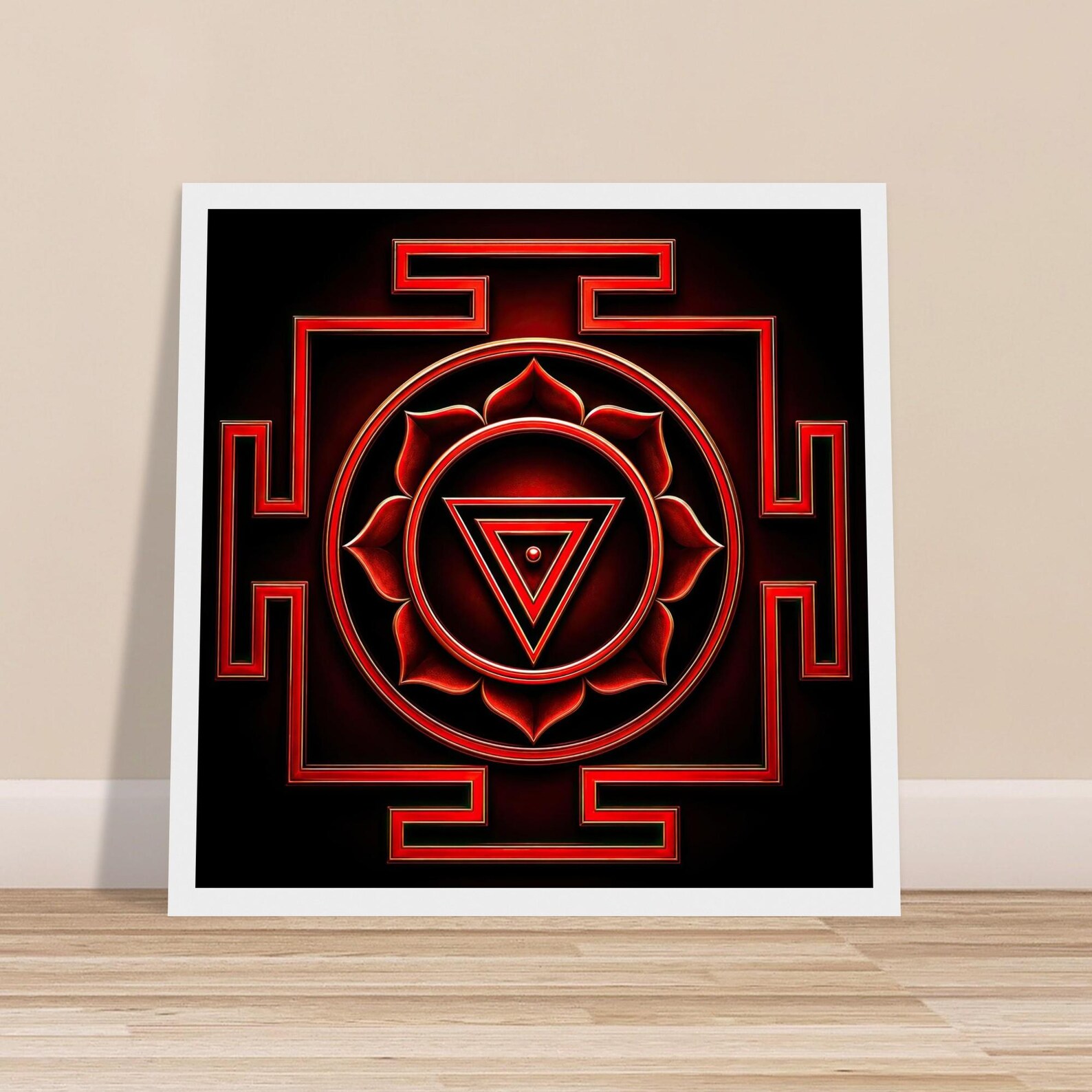
About This Artwork
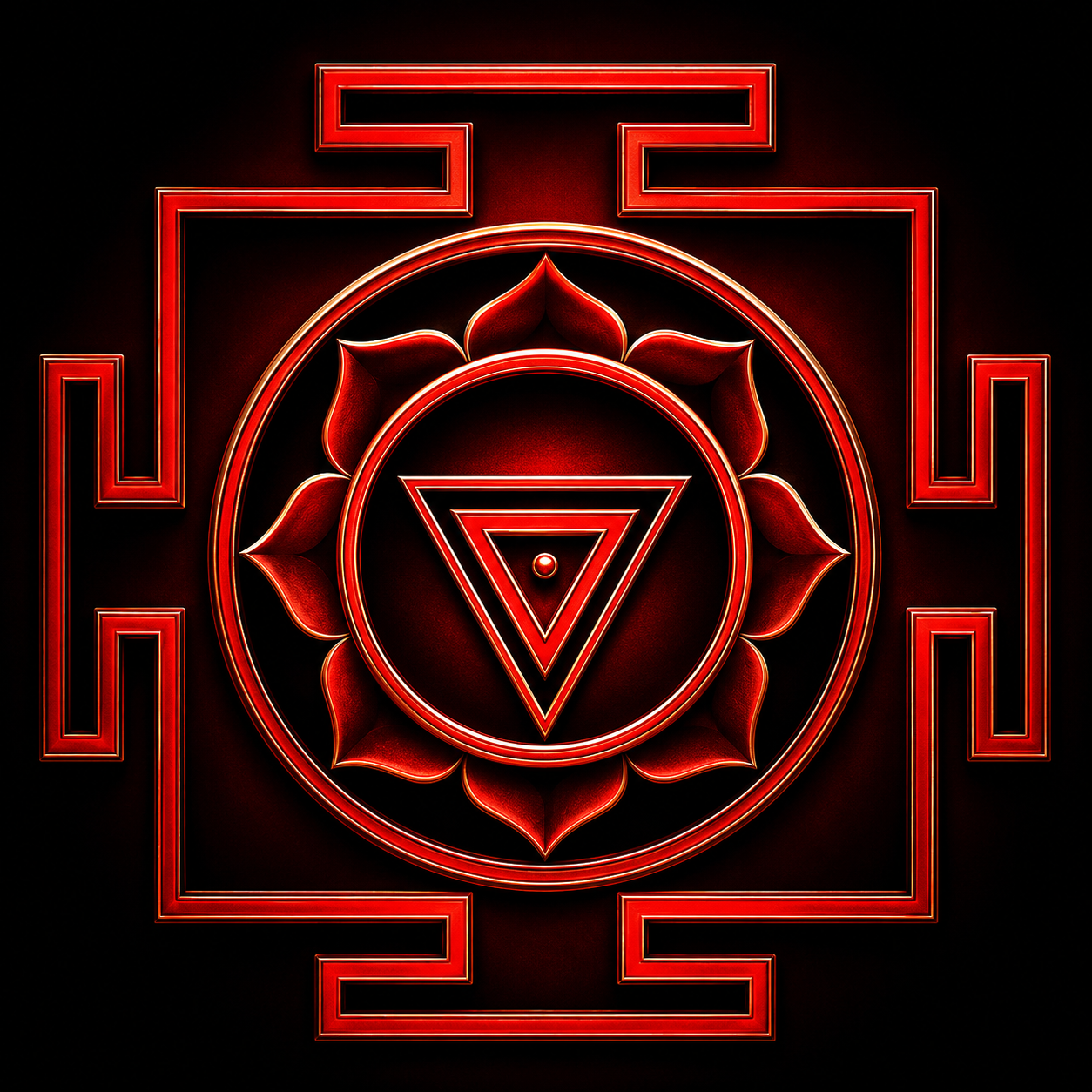
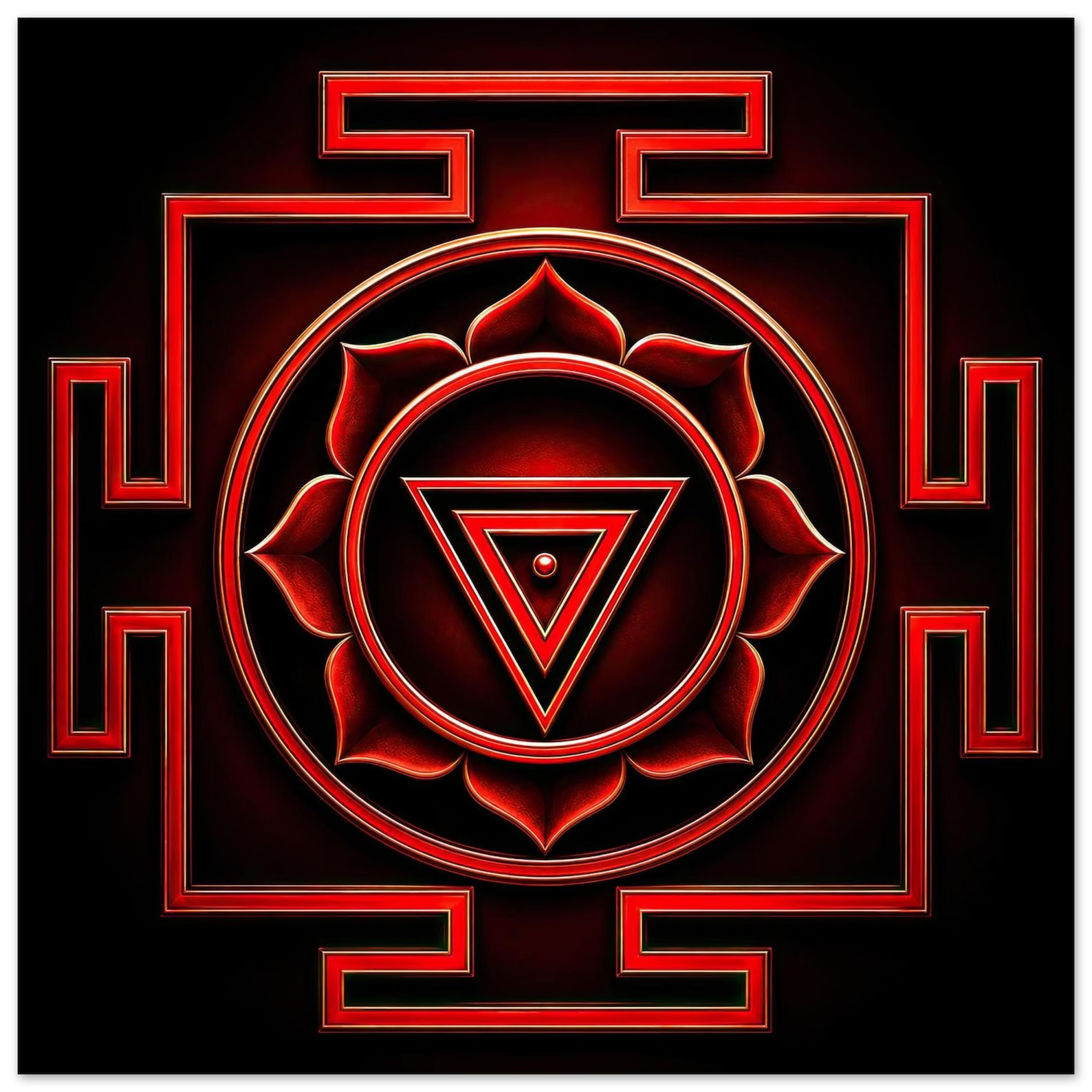
The Kali Yantra is rendered in deep black and gold — the palette most directly associated with Kali's primordial nature. The central downward-pointing triangle is the Shakti trikona: energy descending, water, the feminine principle at its most concentrated. It states geometrically what Kali does — she brings consciousness into the deepest encounter with its own nature, stripping away every false construction until only the golden bindu at the centre remains.
The deep black ground is not empty but full: the primordial darkness from which all colours and all forms arise, the darkness that is the source of light rather than its absence.
First among the Mahavidyas
The Kali Yantra is placed first in any Mahavidya yantra collection, as Kali is first among the ten. Her position is not seniority alone; it is sequence. Nothing in the Mahavidya progression can proceed until what is false has been removed, and that removal is Kali's work.
This makes hers the most direct of the ten yantras and, for many practitioners, the most demanding. It is not a decorative object, and the tradition treats it accordingly.
The downward triangle
A single downward-pointing triangle is Shakti's most primary geometric statement: energy descending into manifestation, the feminine principle undiluted by any counterbalancing form. Where the hexagram yantras show equilibrium, the Kali Yantra shows one force acting without negotiation.
The golden bindu at its centre is what survives the descent — the absolute, unchanged by everything that has been stripped away around it.
Black as fullness
The most important corrective for a viewer new to this imagery: black in the Kali tradition is the colour of primordial fullness, not of absence or evil. It is the night sky that contains every star, the colour that results not from the removal of all colours but from their totality.
Kali's name comes from kala — time, and also the dark. She is what remains when time has taken everything else, which the tradition treats not as loss but as the final clarity.
Display
This is the most intense palette in the collection and suits a dedicated practice space rather than a casual living area. A black square frame is the correct choice.
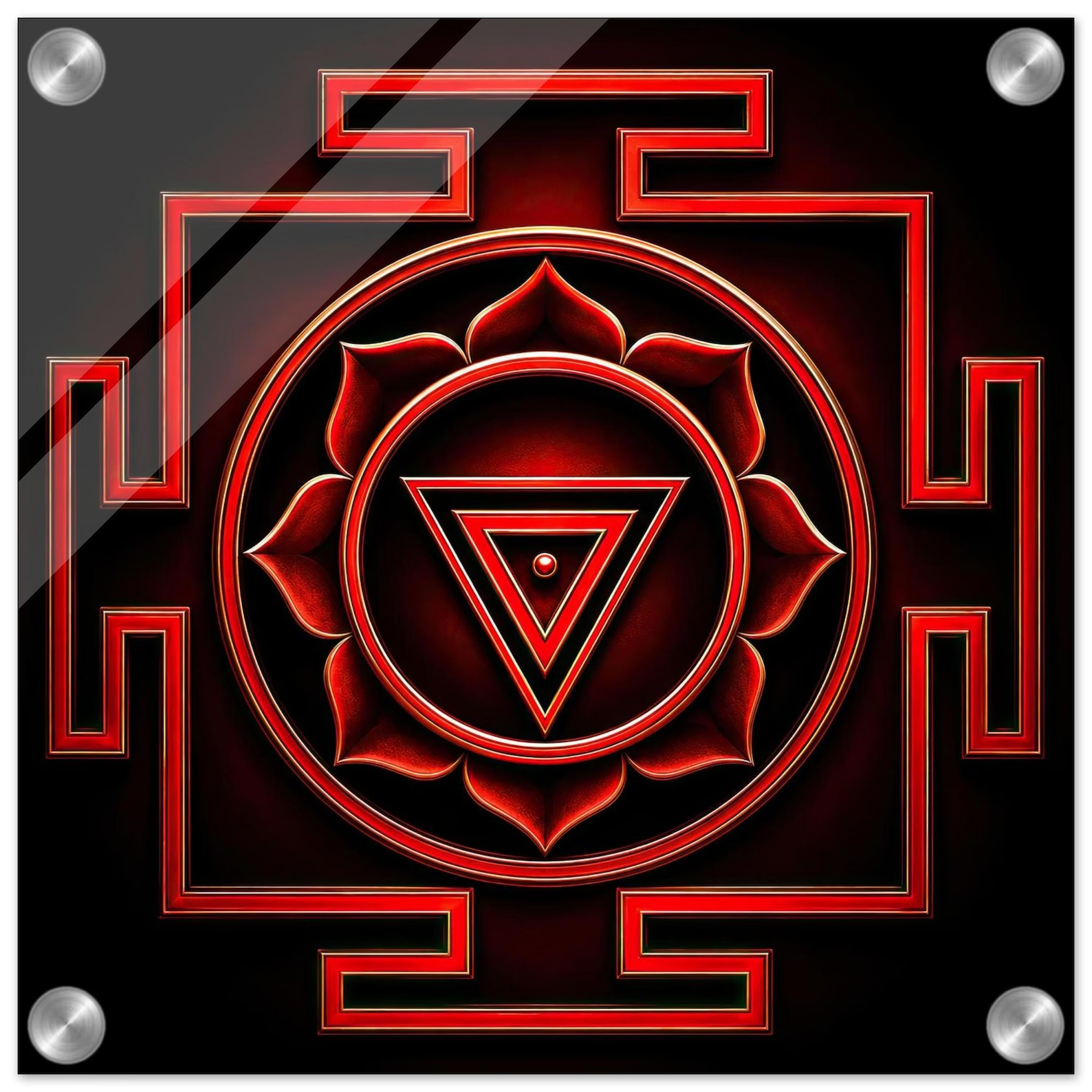
The acrylic format particularly enhances the depth of the black ground against the gold geometry, giving the darkness a physical presence that paper cannot reproduce.
What Is a Yantra?
A yantra — Sanskrit for that which holds or restrains — is a sacred geometric diagram used in the Hindu Tantric tradition as a visual form of the divine. It is not understood as a symbol standing in for a deity, but as the deity expressed in geometry. Where a murti gives the deity human form and a mantra gives the deity sound, the yantra gives the deity line, triangle, circle, petal, and enclosure.
Read from the outside inward, a yantra is built in five stages:
- Bhupura: the outermost square with T-shaped gates on four sides — the four directions, and the four entries into sacred space.
- Lotus petals: one or more rings blooming outward — the opening of consciousness in the deity's presence.
- Circles: cosmic horizon bands — wholeness, and the completion of cycles.
- Central geometry: the triangles, hexagrams, or complex arrangements specific to each deity.
- Bindu: the dimensionless central point — the deity's most concentrated presence, where individual consciousness meets the absolute.
Every yantra artwork in this collection is square. Print it in a square size and frame it in a square frame — standard square frames are widely available at IKEA, Target, Amazon, and most home stores.