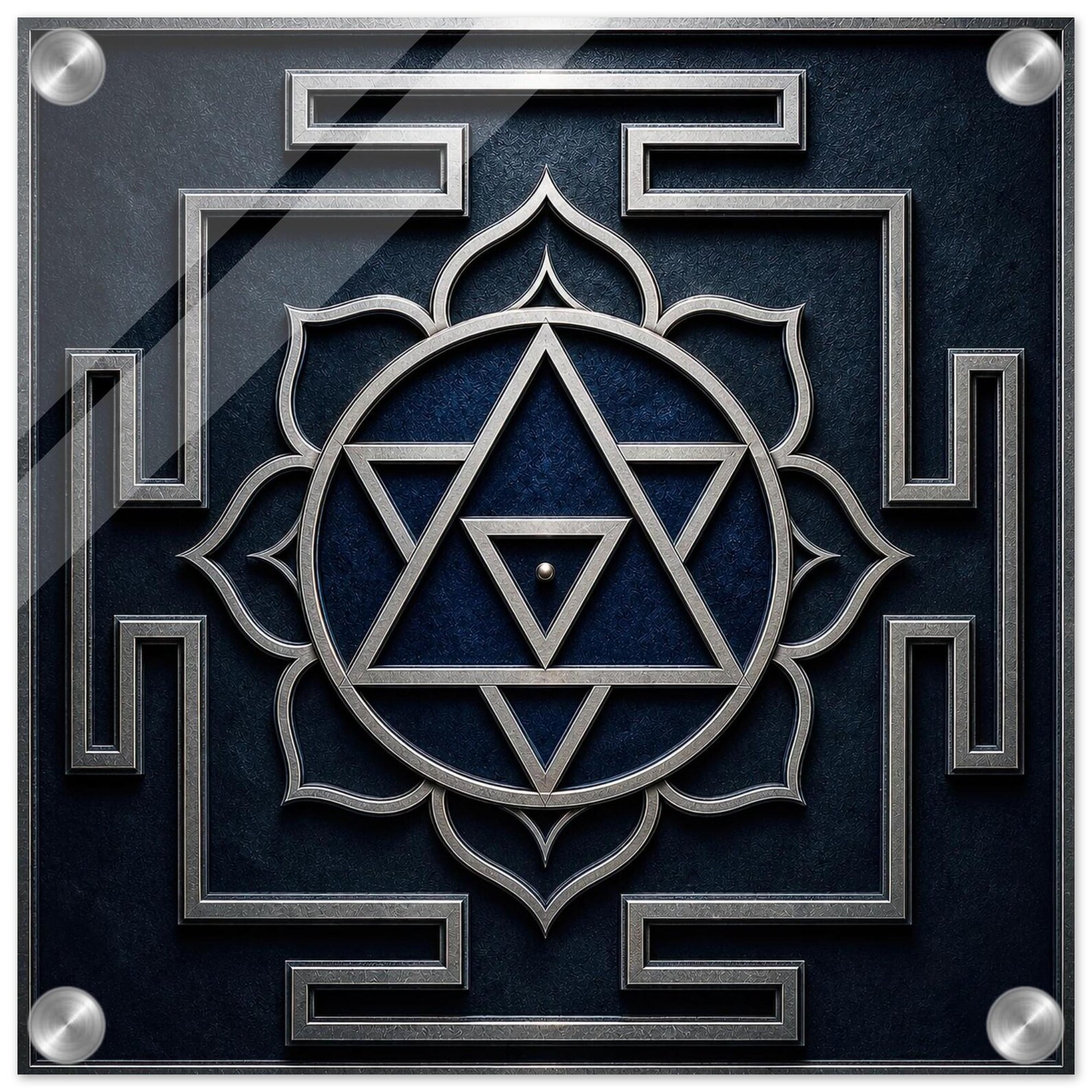
About This Artwork
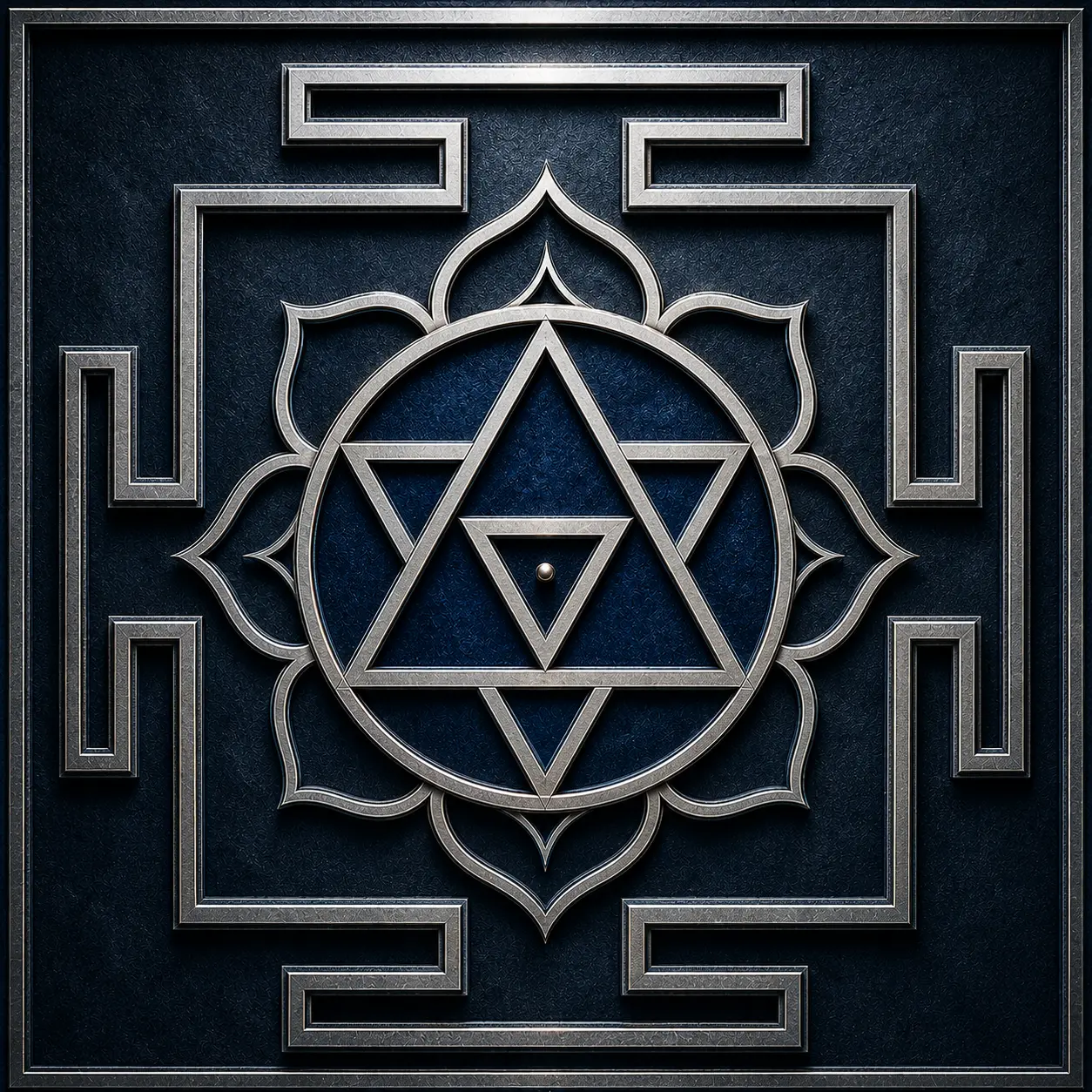
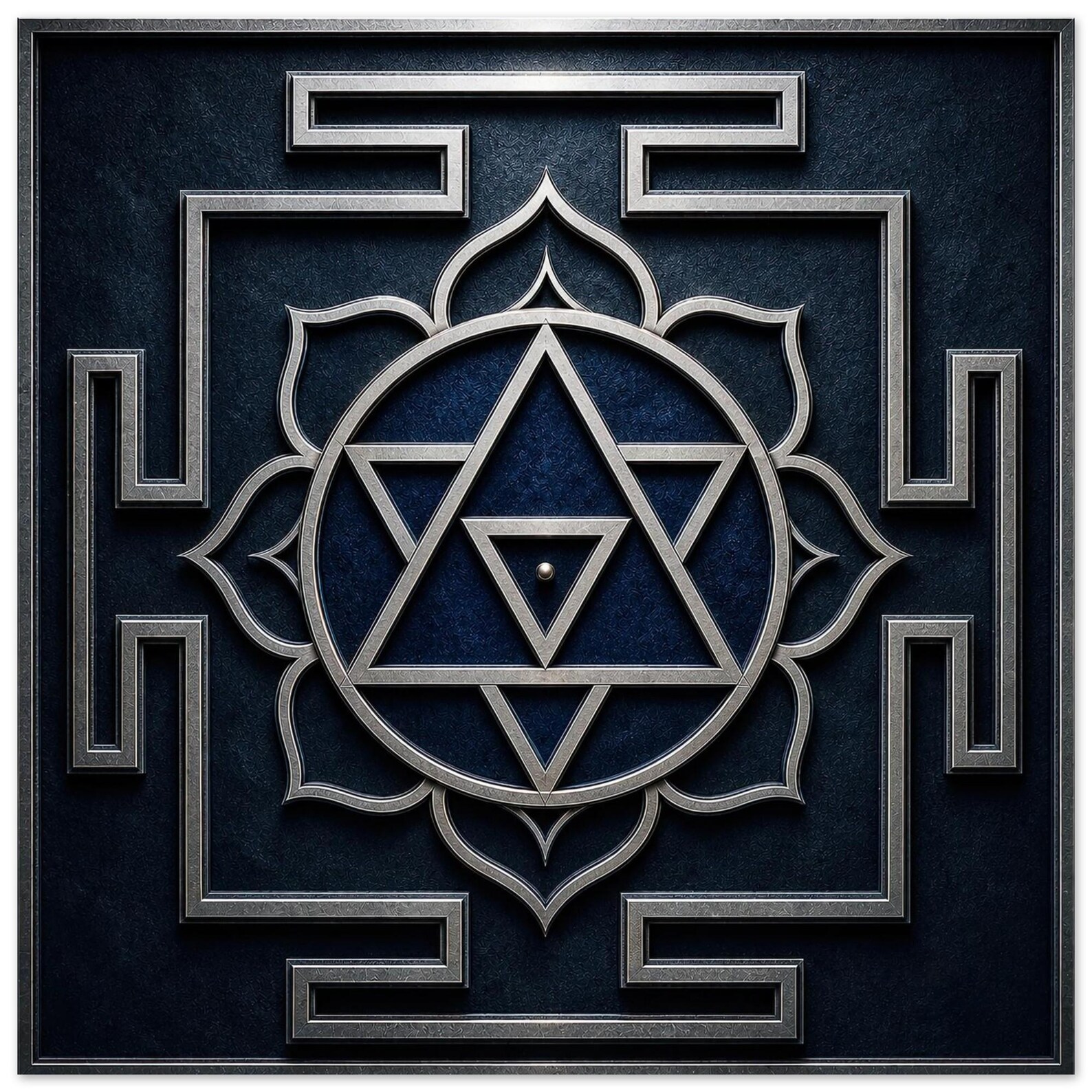
The Shiva Yantra is rendered in the deep indigo and cool silver-white palette of Shiva's visual tradition. The central upward-pointing triangle — the Shiva trikona, the triangle of consciousness rising and of fire ascending — sits within a field of deep indigo: the vast witnessing space of Shiva's awareness.
Lotus petals in muted, contemplative tones encircle the geometry. This is the coolest and most restrained palette of the eight, consistent with Shiva as the cosmic witness whose awareness contains everything without being disturbed by any of it.
The Shiva trikona
A single upward-pointing triangle is the most concentrated geometric statement of the masculine principle: consciousness, fire, the still point that does not move while everything moves within it. Where Shakti yantras multiply and interlock their triangles, the Shiva Yantra reduces.
In the temple tradition, the Shivalinga is Shiva's aniconic physical form — presence without portraiture. The Shiva Yantra is the same idea in two dimensions: the deity given not a face but a form.
A focus for witnessing practice
In Shaiva Tantric practice the Shiva Yantra serves as the geometric focus for meditation on pure witnessing consciousness — the awareness that remains still within all cosmic movement. The eye rests on the apex of the triangle and then on the bindu, and the practice is simply to notice what is doing the noticing.
This is why the palette matters. Nothing in the image is designed to excite attention. The indigo absorbs, the silver clarifies, and the geometry gives the gaze somewhere to settle without giving it anything to chase.
Display and pairing
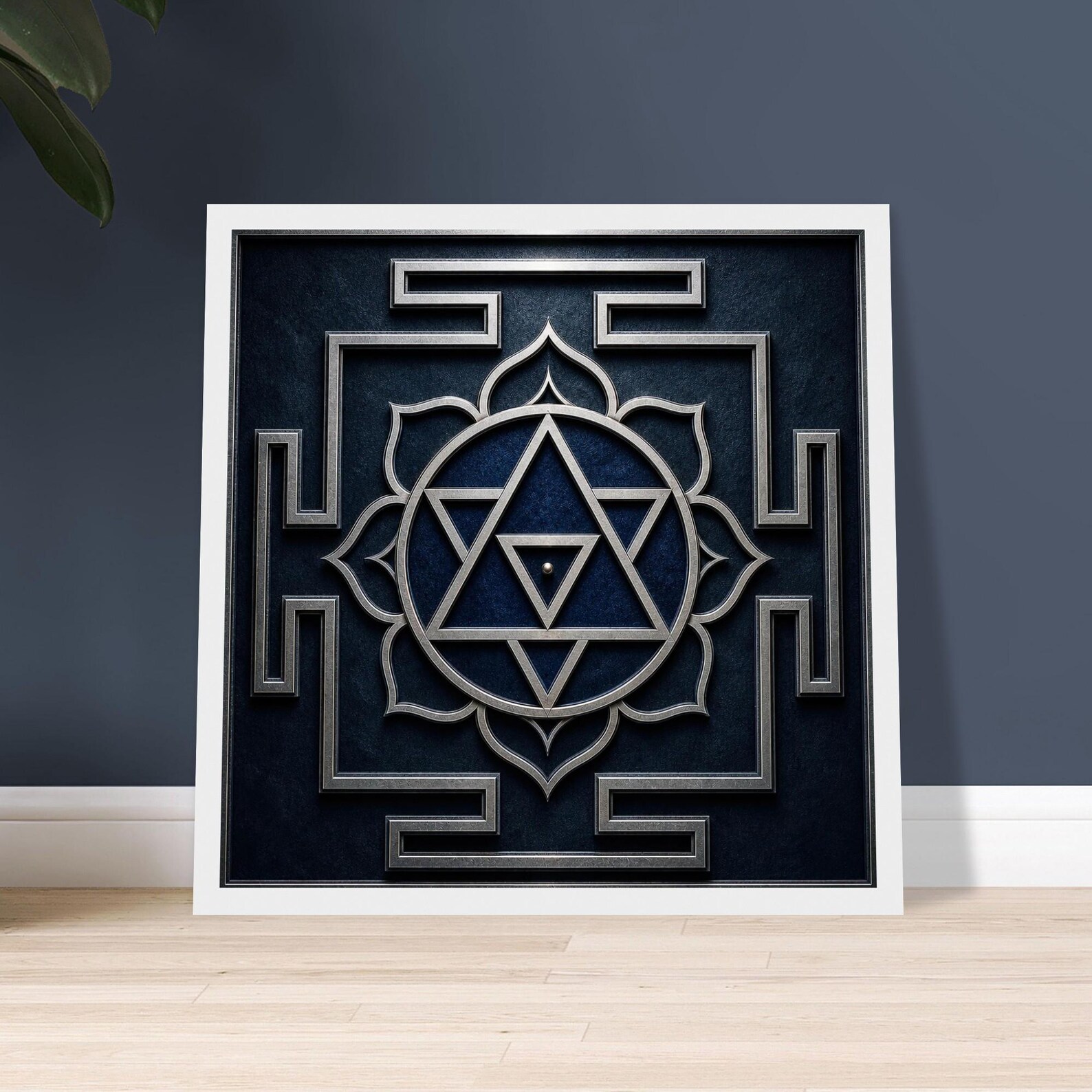
A silver, black, or dark wood square frame suits the cool indigo palette. Meditation rooms, studies, and quiet corners are the natural settings.
The Shiva Yantra pairs naturally with the Shiva Meditation and Nataraja images as a complete Shiva triptych for a practice space: the yogi, the dancer, and the geometry — stillness, movement, and the form that holds both.
What Is a Yantra?
A yantra — Sanskrit for that which holds or restrains — is a sacred geometric diagram used in the Hindu Tantric tradition as a visual form of the divine. It is not understood as a symbol standing in for a deity, but as the deity expressed in geometry. Where a murti gives the deity human form and a mantra gives the deity sound, the yantra gives the deity line, triangle, circle, petal, and enclosure.
Read from the outside inward, a yantra is built in five stages:
- Bhupura: the outermost square with T-shaped gates on four sides — the four directions, and the four entries into sacred space.
- Lotus petals: one or more rings blooming outward — the opening of consciousness in the deity's presence.
- Circles: cosmic horizon bands — wholeness, and the completion of cycles.
- Central geometry: the triangles, hexagrams, or complex arrangements specific to each deity.
- Bindu: the dimensionless central point — the deity's most concentrated presence, where individual consciousness meets the absolute.
Every yantra artwork in this collection is square. Print it in a square size and frame it in a square frame — standard square frames are widely available at IKEA, Target, Amazon, and most home stores.