
About This Artwork
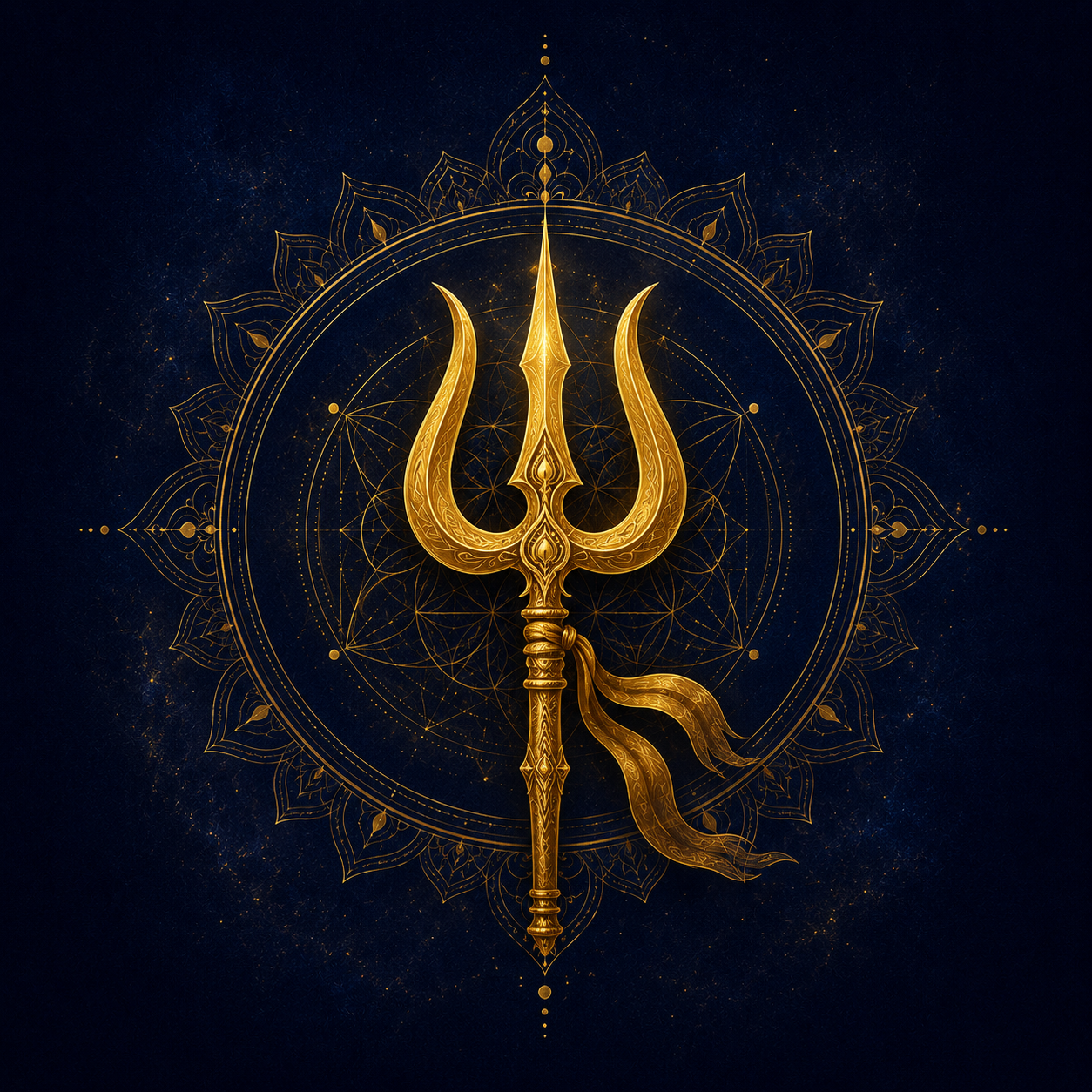
This artwork depicts the Trishul Mandala — Lord Shiva's divine trident (trishul) rising from the centre of an intricate circular mandala of sacred geometric patterns. The trishul itself is rendered in luminous gold with fine line engraving detail and a flowing ribbon or flag at the junction of the prongs and the shaft — a detail present in classical depictions of the trishul in its living temple form, where it is not simply a weapon but a sacred object that is actively worshipped and adorned. The three prongs rise from the shaft with absolute precision, each distinct and perfectly formed.
Around the central trishul, the mandala extends outward in concentric rings of fine gold geometric patterns — circles, floral motifs, radially symmetric arrangements — set against a deep cosmic blue that is both the background of the composition and the visual register of the infinite space in which Shiva's consciousness dwells. The palette — deep cosmic blue, midnight black at the edges, brilliant gold for every geometric element — is the most specifically Shaiva in the collection, sharing the deep indigo-blue of the Shiva Meditation and Shiva Yantra images while adding the dramatic gold of the trishul at the composition's centre.
The composition differs from the other mandala pieces in this section in one important way: it has a clear axial orientation — the trishul rises vertically from the centre of the circle, giving the piece a directionality that the purely circular Sacred Mandala and Golden Lotus compositions do not have. The trishul is always vertical; this is the correct orientation for display.
About the Trishul — Shiva's Divine Trident
The Trishul (Sanskrit: three-pointed) is the primary attribute of Lord Shiva — the weapon, the symbol, and the living geometric statement most directly and most completely associated with Shiva's nature and domain. Where the Sudarshana chakra identifies Vishnu, where the lotus identifies Lakshmi, and where the peacock feather identifies Krishna, the Trishul identifies Shiva — immediately, unambiguously, across every regional tradition and every historical period.
But the Trishul in the Shaiva tradition is not simply a weapon or a symbol of power. It is a map — a three-dimensional geometric statement about the fundamental structure of all of existence, inside and outside, cosmic and personal. Each of the three prongs represents a triad that the tradition understands as fundamental to the organisation of reality.
What the Three Prongs Represent
The three prongs of the trishul are identified with multiple triads across different dimensions of the Shaiva cosmological vision:
The three nadis: In the subtle body of Tantric and yogic understanding, the three principal energy channels (nadis) are Ida (the left, lunar, cooling channel), Pingala (the right, solar, heating channel), and Sushumna (the central channel, through which the awakened Kundalini rises toward the crown). The Trishul's three prongs are the three nadis — Ida to the left, Pingala to the right, Sushumna at the centre — the shaft of the trishul being the spine through which all three run. To place the Trishul mandala in a practice space is to place a visual map of the subtle body at the centre of that space.
The three gunas: Tamas (inertia, heaviness, darkness), Rajas (activity, passion, heat), and Sattva (clarity, balance, luminosity) — the three qualities that in Samkhya-Yoga philosophy constitute the entire range of manifest existence. Everything that appears in the world is a particular configuration of these three qualities. The Trishul as the map of the three gunas is Shiva's sovereignty over the entire field of manifest existence.
The three states of consciousness: Jagrat (waking), Svapna (dreaming), and Sushupti (deep sleep) — the three states through which ordinary consciousness cycles. The trishul's three prongs represent these three states; the shaft represents the fourth state (turiya, pure witnessing awareness) that underlies and transcends all three — Shiva's consciousness that is always already present, witnessing the three states without being any of them.
The three Shaktis: Iccha Shakti (the power of will), Jnana Shakti (the power of knowledge), and Kriya Shakti (the power of action) — the three fundamental powers through which Shiva's consciousness expresses itself in creation.
The Trishul as Sacred Object — Temple Worship
In the living temple tradition of South and North India, the Trishul is not only depicted in Shiva's hands in iconic form but is itself worshipped as an independent sacred object — installed in the temple, adorned with flowers and ribbons, offered to with incense and lamp, and understood as Shiva's direct presence in the object itself.
This is the tradition that the flowing ribbon at the junction of the prongs and the shaft in this artwork references: the ribbons and flower garlands tied to the trishul in temple worship, marking it as an active, living object of devotion rather than a historical artifact or a decorative symbol. The Trishul in this artwork is not a representation of a weapon; it is a visual form of the living sacred object as it appears in devotional worship.
The Trishul Mandala — The Symbol in Sacred Geometry Context
The placement of the Trishul at the centre of a mandala in this artwork is a specific and significant compositional choice. The mandala — the circle of cosmic order — and the Trishul — the map of the three fundamental forces — together constitute a complete visual statement about the nature of Shiva's consciousness: the Trishul as the content (the three forces of existence), the mandala as the container (the infinite space of Shiva's awareness within which the three forces arise).
The composition is distinct from the pure mandala works elsewhere in this section: where the Sacred Mandala and the Golden Lotus Mandala are centripetal (drawing the eye inward toward the still centre), the Trishul Mandala is both centripetal and axially directed — the eye is drawn inward and also upward, following the vertical rise of the trishul toward the three prongs and their implied continuation into the space above the composition.
Displaying the Trishul Mandala
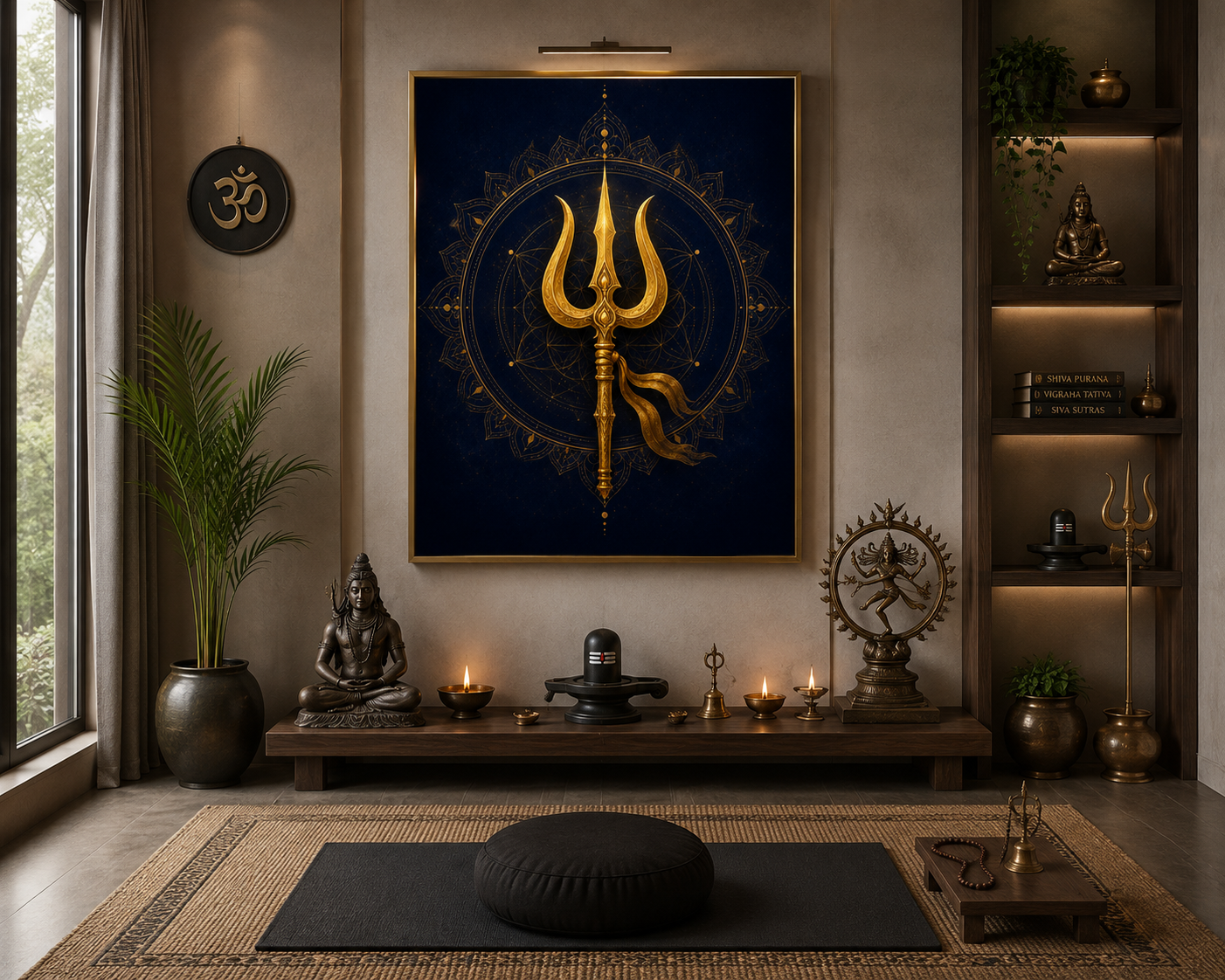
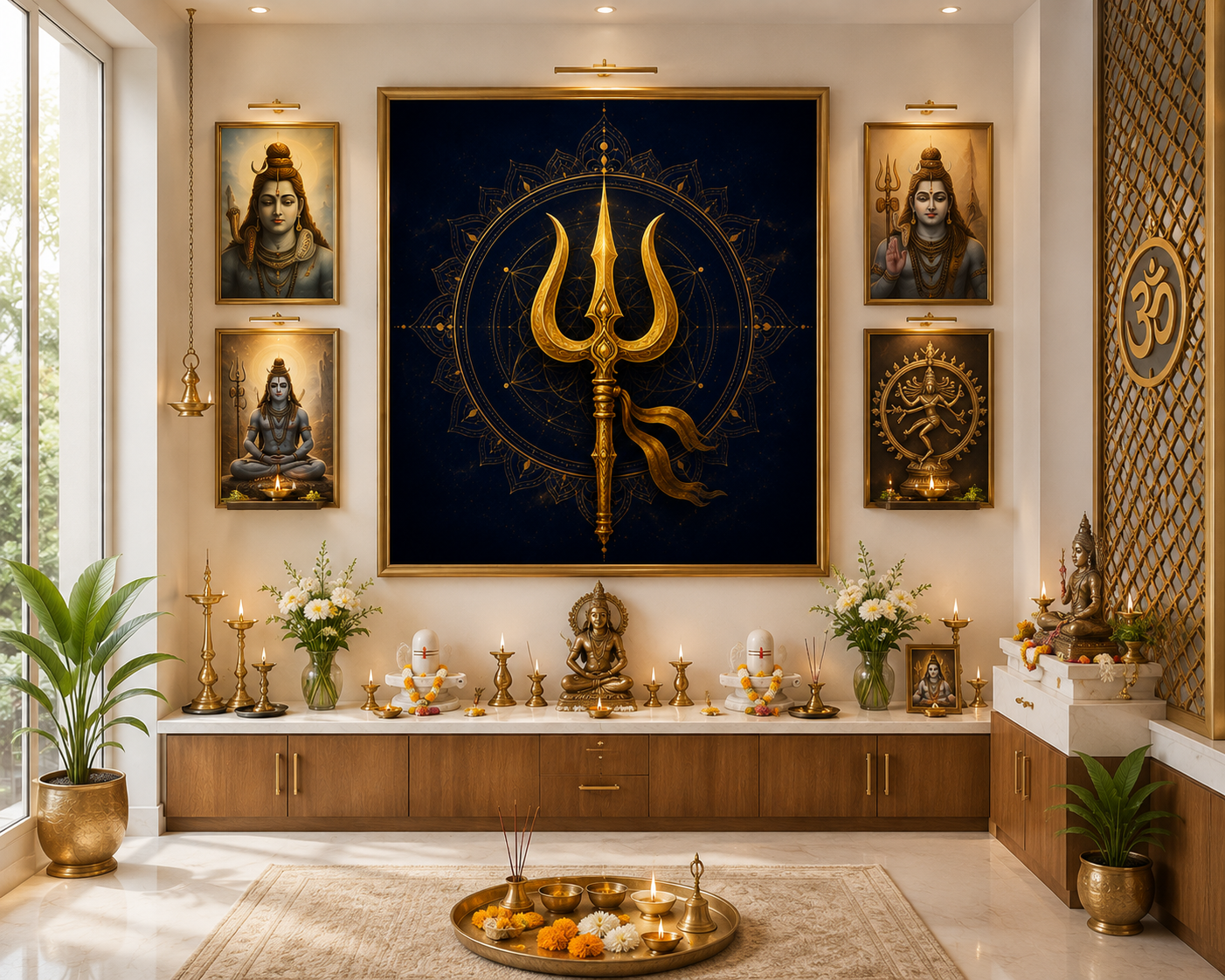
The Trishul Mandala is the most specifically Shaiva piece in the Yantras & Sacred Symbols section and the one most naturally placed alongside the other Shiva images in the collection (the Shiva Meditation, the Nataraja, the Shiva Yantra, Dakshinamurti). In a Shaiva practice space it completes the picture: the figurative forms of Shiva are accompanied by his primary sacred symbol in its geometric and devotional form.
The trishul must be oriented vertically in display — this is the correct iconographic orientation. Horizontal display would be incorrect and should be avoided.
The deep blue and gold palette suits a dark wood or black frame. Print on matte paper for the deepest rendering of the cosmic blue background. A square or portrait-oriented frame both work for this composition.